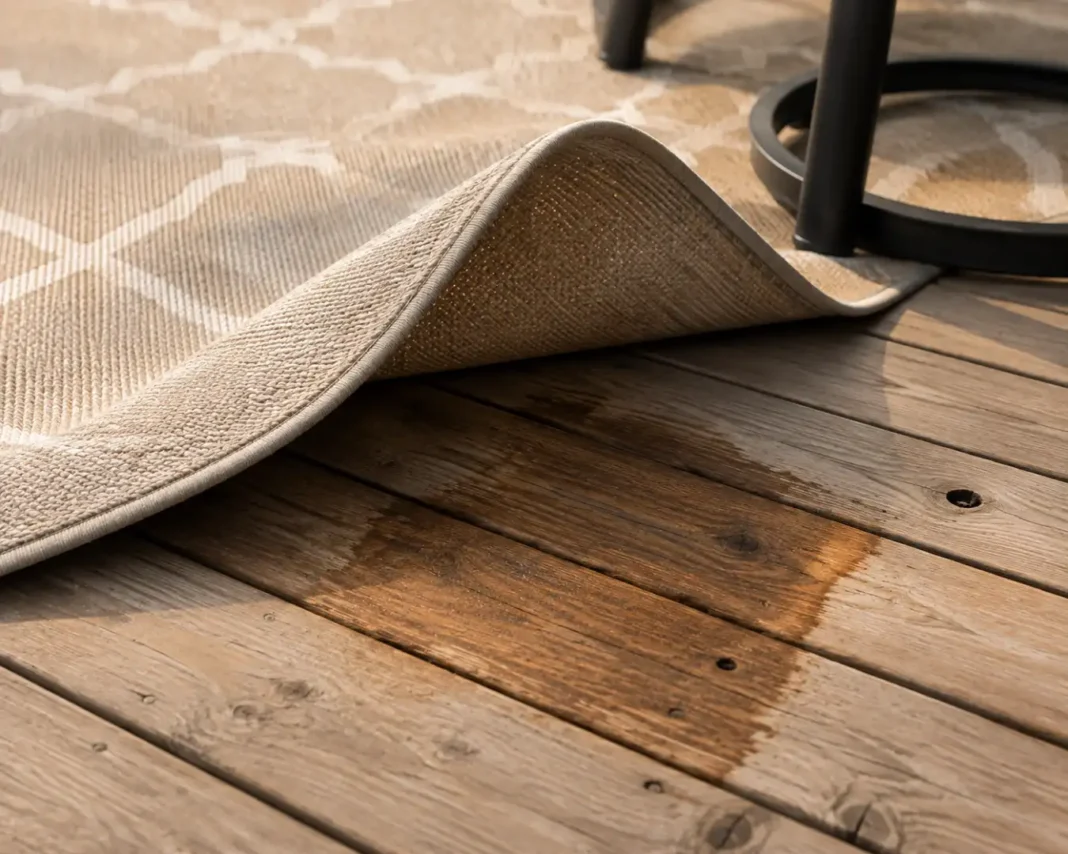

Outdoor Rug Wooden Deck: Keep Your Boards Safe

An outdoor rug wooden deck combination gets blamed for damage it usually didn’t cause on its own. The real problem is almost always what’s trapped underneath it, not the rug fabric itself. That’s true whether your rug cost twenty dollars or two hundred dollars total. We think this is one of the most overlooked deck care issues, since the damage builds slowly and stays invisible until you finally lift the rug and find soft, discolored boards.
You don’t need to replace your deck or your rug to fix this; just understand what’s actually happening underneath. In this guide, we’ll walk you through five practical, tested steps, from backing material to a simple maintenance habit that prevents most of the damage entirely. Let’s get into it.
5 Safety Guides for Your Outdoor Rug and Wood Deck
Every risk tied to an outdoor rug wooden deck setup comes down to five things: what carpet backing does to the boards, what a rubber backing does differently, which material is actually safest to buy, how fast you can dry a soaked rug, and whether natural fiber rugs like jute mold faster than synthetic ones.
Each guide below covers one of those five, starting with the two most common mistakes and ending with the material question most people ask before they even buy a rug.
Outdoor Carpet and Wood Deck Rot
Loose weave, breathable carpet backing lets air move through and dries fast on an outdoor rug wooden deck setup. Solid rubber or vinyl backing seals water against the wood instead, and that speeds up rot, warping and mold within a few humid weeks.
Check the backing label before you buy. No mention of drainage or a breathable weave means treat it as high risk on wood. Our full breakdown of how carpet backing affects deck rot covers the specifics if you want to go deeper.
| Number & Insight | Source (Institute) | Expert / Team |
|---|---|---|
| CRI installation standards call for unrolling carpet in a ventilated area for 24 hours or more before securing it. | Carpet and Rug Institute, CRI 104/105 Installation Standards | CRI Installation Standards Committee |
| Industry moisture testing (the calcium chloride test) measures vapor emission from a surface before carpet is installed professionally. | Carpet and Rug Institute Technical Bulletins | CRI Test Standards Committee |
Rubber-Backed Rugs and Deck Damage
A rubber backing creates an airtight seal between the rug and boards in an outdoor rug wooden deck pairing, so any water that gets underneath has nowhere to evaporate. Over one humid season, that trapped moisture can warp boards and invite mold you won’t see until you lift the rug.
Already own one? Slide a breathable pad underneath rather than replacing it. Our guide on how rubber-backed rugs damage wood decks covers the warning signs in more detail.
| Number & Insight | Source (Institute) | Expert / Team |
|---|---|---|
| The WFCA advises against solid rubber or latex backing directly on wood flooring, since trapped humidity can damage the finish. | World Floor Covering Association, Consumer Guidance | WFCA Flooring Standards |
Safest Rug Materials for a Wooden Deck
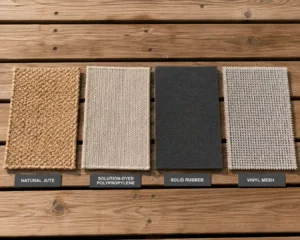
The safest backing for an outdoor rug wooden deck pairing is one that lets water pass through instead of pooling against the wood. The EPA’s guide on mold and moisture notes that mold can begin growing on a damp surface within just 24 to 48 hours, and research from the USDA Forest Products Laboratory shows wood-decay fungi generally need moisture content above roughly 20 percent to activate.
| Number & Insight | Source (Institute) | Expert / Team |
|---|---|---|
| Mold can start growing on a damp surface within just 24 to 48 hours. | U.S. EPA, “A Brief Guide to Mold, Moisture, and Your Home” | EPA Indoor Air Quality Division |
| Wood decay fungi become active once moisture content climbs above about 20 percent. | USDA Forest Products Laboratory | USDA FPL Wood Durability Research |
A rug that traps water against the boards can push a section of decking past that threshold far faster than the open boards around it. Open-weave and perforated backings dry at close to the same rate as the bare boards beside them, which is exactly why they carry the lowest risk of the group. Price, color and brand name matter far less than this one detail when you’re shopping for a rug meant for wood.
Fast Drying Methods for Outdoor Rugs on Decks
Standing a rug upright against a railing in sun and wind dries an outdoor rug wooden deck combination roughly twice as fast as leaving it flat, since flat rugs trap moisture against both the fibers and the deck boards at once. Prop it on edge, add a fan if there’s no wind, and sweep the bare boards underneath before it goes back down. Our detailed guide on drying an outdoor rug fast covers the full step-by-step version of this process.
| Number & Insight | Source (Institute) | Expert / Team |
|---|---|---|
| Airflow across a wet surface is one of the biggest factors in evaporation speed, since moving air replaces the saturated boundary layer. | AATCC (American Association of Textile Chemists and Colorists) | AATCC Drying Rate Research |
Jute Rugs and Mold on Patios
Jute is a natural, absorbent fiber that holds onto humidity instead of shedding it, so in a shaded or poorly ventilated spot on an outdoor rug wooden deck, it can develop mildew spots within a couple of damp weeks, even without direct rain.
It still works outdoors in a sunny, airflow-heavy spot if you shake it out weekly. Our full guide on whether jute molds on an outdoor patio covers exactly how to manage it season by season.
| Number & Insight | Source (Institute) | Expert / Team |
|---|---|---|
| Jute’s official moisture regain is 13.75%, versus roughly 0% for synthetic fibers like polypropylene, meaning jute holds water far longer. | ASTM D1909, Standard Tables of Commercial Moisture Regains for Textile Fibers | ASTM Textile Standards Committee |
Covered Patio Rugs That Stay Dry Under $25
This keyword is a Budget-format search, since people asking about covered patio rugs are usually comparing product cost and upkeep, not counting steps. A covered patio rug can lean toward denser weaves since it’s shielded from direct rain, but on an outdoor rug wooden deck setup, solution-dyed polypropylene still outperforms natural fibers even under cover, because shade and humidity combine to slow drying time regardless of rain exposure.
A breathable rug pad under $25 closes most of the remaining gap for a covered space. Rotate the rug every few weeks even though it isn’t taking direct weather, since shaded moisture from dew and humidity builds up just as quietly as rain does on an open deck.
2 Ways to Stop Furniture Legs From Damaging Your Deck
This keyword is a Number-format search, since the searcher wants a short, countable list of fixes rather than a cost comparison. Furniture legs cause pressure indentation, not moisture rot, so the fix is completely different from anything covered in the guides above. Wide coasters, moved every few months, work better on wood decks than felt or rubber leg caps alone.
If you already run a rug on your deck, tuck the coasters under the rug’s edge rather than the open boards for a cleaner look. Check underneath coasters the same way you’d check underneath a rug, since trapped moisture can build up there too on a shaded deck.
3 Perfect Rug Sizes for a 10×10 Deck
This keyword is also a Number-format search, since it’s really asking for a short set of size options rather than a price point or a step-by-step guide. An 8×10 rug leaves a clean 12-inch wood border visible around the edges, which reads as more intentional than a rug cut to your deck’s exact footprint, and that border stays free to dry in open air every day.
Smaller decks do better with a 6×9 rug centered under just the seating area, while larger decks, 12×12 and up, can support a full 9×12 without losing that breathing border. Our guide on why outdoor solar lights stop working covers a separate issue worth checking if you’re rearranging furniture and lighting around a new rug at the same time.
Conclusion
An outdoor rug wooden deck combination can coexist without damage as long as moisture never sits trapped between them for long. Choose a breathable backing, add a rug pad if you’re keeping one you already own, and build a simple lift-and-check habit into your regular deck routine, checking every couple of weeks in humid months and once a month during the drier, quieter stretches of the year.
None of this requires replacing your outdoor furniture or redoing your whole deck. It just requires treating the rug as one more thing to maintain, the same way you’d maintain the railing or the stain finish. Pick one change from this guide, a breathable pad or a simple two-week reminder and start there before you buy anything new.
Frequently Asked Questions (FAQs)
Can you put an outdoor rug on a wooden deck?
Yes, you can put an outdoor rug on a wooden deck safely if you choose a breathable backing and lift it regularly to check for trapped moisture underneath. The rug itself isn’t the risk; moisture trapped against the boards for days at a time is what actually causes damage.
Can you leave an outdoor rug on a deck all winter?
It’s better to store it indoors or in a dry shed if you can. Freeze-thaw cycles trap moisture against your boards and can crack a rug’s backing over a cold winter.
Do outdoor rugs need a rug pad on a wood deck?
Yes, especially on an outdoor rug wooden deck setup where the rug’s own backing is solid rather than breathable. A pad lifts the rug slightly and lets air move underneath, which cuts down on trapped moisture significantly.
How often should you clean an outdoor rug on a deck?
Rinse and air-dry it every four to six weeks, and sweep underneath it every time you lift it to check your boards for early staining.
Will a wet rug stain a wood deck?
Yes, a rug left wet for more than a day or two can leave a visible dark outline on unsealed or lightly finished wood, so drying it promptly matters more than most people expect.