Why You Should Weatherproof Outdoor Wooden Furniture Before Damage Starts


Yes, you can weatherproof outdoor wooden furniture well enough to add years to its life, using a water-repellent sealant or exterior finish applied before the wood takes real sun and rain damage. A single coat alone falls short; two coats and regular reapplication are what actually hold up over time.
Key Takeaways:
- Two-coat finish systems last roughly 10 years, nearly double a single coat.
- Water-repellent preservatives alone need reapplication every 1 to 2 years.
- A basic sealing kit runs under $40 for a standard patio set.
- Full application takes an afternoon, drying time included.
- Skipping end-grain sealing is the most common reason wood rots first at the legs.
This guide shows how to weatherproof outdoor wooden furniture itself, plus four related seasonal care projects homeowners search for just as often, from soaked rugs to rusting metal frames. Keep reading to find the exact fix for the specific problem sitting on your patio right now before the next big storm arrives.
Five Seasonal Patio Care Projects Worth Knowing
Wood is not the only material that struggles outdoors. Rugs trap rainwater, cushions trap moisture and grow mildew, potted plants tip in wind and metal frames rust long before the fabric or wood ever fails. The five guides below cover wood weatherproofing and four related seasonal fixes, starting with the wood itself.
Keeping an Outdoor Rug Dry in the Rain
A soaked outdoor rug left flat on a deck traps moisture against the boards underneath, which speeds up rot in both the backing and the wood. The EPA notes that materials dried within 24 to 48 hours of getting wet generally will not develop mold. The table below details the official drying-window guidelines established by EPA specialists.
| Number & Insight | Source (Institute) | Expert / Team |
|---|---|---|
| Items and materials dried within 24 to 48 hours of getting wet generally will not develop mold, which makes fast drying more effective than any cleaning product. | U.S. Environmental Protection Agency | EPA Mold Prevention Program |
Standing the rug upright after rain lets air reach the backing from both sides, so it dries far faster than one left flat against the deck. Our full guide on how to keep an outdoor rug dry in the rain covers drainage mats and rotation schedules.
Preventing Outdoor Cushions From Smelling Musty
Foam cushions hold moisture deep inside long after the fabric surface feels dry, which is exactly where mildew gets started. Wikipedia’s indoor mold entry explains that mold needs moisture, food and warmth, so removing any one stops new growth. The table below details the mold-growth condition guidelines established by Wikipedia specialists.
| Number & Insight | Source (Institute) | Expert / Team |
|---|---|---|
| Mold needs moisture, a food source and warmth to grow and removing any one of the three reduces or stops new growth, which is why a cushion that dries completely stays fresh. | Wikipedia (Indoor mold) | Wikipedia Contributors |
Standing cushions on edge after rain lets air reach both sides. Our full guide on how to prevent outdoor cushions from smelling musty covers foam types that resist moisture best.
Weatherproofing Outdoor Wooden Furniture With Sealant

Wood left exposed to weather for more than two weeks starts losing its ability to hold a finish at all. According to the USDA Forest Products Laboratory, two coats of quality exterior finish over a properly applied primer can last roughly 10 years, nearly double the 4 to 5 years a single coat typically provides. The table below details the official finish-durability guidance established by the USDA Forest Products Laboratory.
| Number & Insight | Source (Institute) | Expert / Team |
|---|---|---|
| Two coats of quality exterior finish applied over a properly prepared primer can last roughly 10 years, compared to 4 to 5 years for a single coat alone. | USDA Forest Products Laboratory | FPL Wood Protection and Finishing Research Team |
To weatherproof outdoor wooden furniture well, pair a water-repellent preservative with a UV-inhibiting topcoat, which helps limit grain raising and surface checking. Sealing exposed end grain, the most porous part of any board, matters as much as the flat surfaces, since moisture wicks in fastest there.
Protecting Potted Plants From Wind Tipping
A top-heavy planter catches wind like a sail once the plant inside grows large enough. University of Illinois Extension advises choosing a pot with a base broader than its height to minimize overturning and strapping or anchoring tall plants that grow top-heavy. The table below details the container-stability guidelines established by University of Illinois Extension specialists.
| Number & Insight | Source (Institute) | Expert / Team |
|---|---|---|
| A pot with a base broader than its height minimizes overturning and tall plants that become top-heavy should be strapped or anchored in place, especially on exposed balconies, rooftops and decks. | University of Illinois Extension | Illinois Extension Container Gardens Team |
A wide, low container does more against gusts than any trick added afterward. Our full guide on how to protect potted plants from wind tipping covers weighting methods for taller planters.
Stopping Outdoor Metal Furniture From Rusting
Bare metal exposed to repeated wet-dry cycles rusts far faster than metal that stays dry or protected by a coating. According to the American Galvanizers Association, zinc corrodes at roughly one-thirtieth the rate of steel in the same atmospheric exposure. The table below details the official corrosion-rate guidelines established by American Galvanizers Association specialists.
| Number & Insight | Source (Institute) | Expert / Team |
|---|---|---|
| Zinc corrodes at roughly one-thirtieth the rate of steel in the same atmospheric exposure, which is why a galvanized coating slows rust on steel so effectively. | American Galvanizers Association | AGA Technical Services Committee |
Wiping down metal frames after rain, rather than letting water sit in joints and welds, prevents the wet-dry cycling that drives surface rust fastest. Our full guide on how to stop outdoor metal furniture from rusting covers rust-inhibiting coatings in detail.
How Much Does It Cost to Weatherproof Outdoor Wooden Furniture (Under $40)
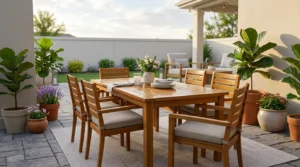
A basic kit to weatherproof outdoor wooden furniture in a standard patio set typically costs under $40, covering a water-repellent sealant or exterior finish and basic application tools. Premium marine-grade spar urethane or teak oil can push the total closer to $70 for a full set.
Professional refinishing services generally charge $150 to $300 depending on furniture size and condition. For most residential sets, the DIY route handles the job just as effectively for a fraction of that price.
How Many Coats of Sealant Does Outdoor Wood Need (2 Coats Minimum)
Two coats of sealant are the minimum to weatherproof outdoor wooden furniture meaningfully, since a single coat wears through within a season on surfaces that see regular sun and rain. A third coat on high-wear areas like armrests and tabletops extends protection further in harsh climates.
Allowing full drying time between coats, rather than rushing the second application, matters more than the brand of sealant used.
How Often Should You Reapply Wood Sealant Outdoors (Every 1 to 2 Years)
Water-repellent preservatives typically need reapplication every 1 to 2 years, while a full two-coat exterior finish can stretch that interval closer to 5 years before a touch-up is needed. Furniture in full, unshaded sun generally needs more frequent reapplication than furniture under a covered patio.
Checking for water absorption, splashing a few drops on the surface and watching whether they bead or soak in, is a quick way to tell if reapplication is due.
Conclusion
Weatherproof outdoor wooden furniture is not a one-time project; it is a maintenance rhythm that keeps the same set looking good for a decade instead of needing replacement. The five guides above cover wood sealing and the seasonal problems that show up alongside it on most patios.
Match the fix to whichever material is struggling on your patio, then see our guide on how to hang outdoor string lights without drilling for another no-drill upgrade. Try resealing one piece this weekend, then tell us in comments how it held up or share this guide with a friend whose patio could use the same care.
Frequently Asked Questions (FAQs)
How do you weatherproof outdoor wooden furniture?
You weatherproof outdoor wooden furniture by cleaning and lightly sanding the surface, applying a water-repellent preservative or exterior finish in two coats, sealing exposed end grain carefully and reapplying every 1 to 5 years depending on the product and sun exposure.
Does teak need to be sealed to survive outdoors?
Teak does not need to be sealed to survive outdoors, since its natural oils protect the wood on their own, though sealing keeps the original honey color from fading to the natural gray patina that unsealed teak develops over time.
Can you weatherproof wood that already has water damage?
Wood with water damage can often be weatherproofed if the damage is limited to surface graying or minor checking, but wood with soft, spongy spots indicating rot needs repair or replacement before any sealant is applied, since sealing over active rot traps moisture in.
What is the best season to weatherproof outdoor furniture?
Late spring or early summer is generally the best season to weatherproof outdoor furniture, since the wood needs several dry, moderate-temperature days for the sealant to cure fully before heavy rain or intense sun exposure begins.
Does painted outdoor wood need the same weatherproofing as stained wood?
Painted outdoor wood needs the same underlying weatherproofing principles as stained wood, a quality primer and two topcoats, though paint generally lasts longer than stain since the pigmented film blocks more UV exposure than a semitransparent stain allows through.