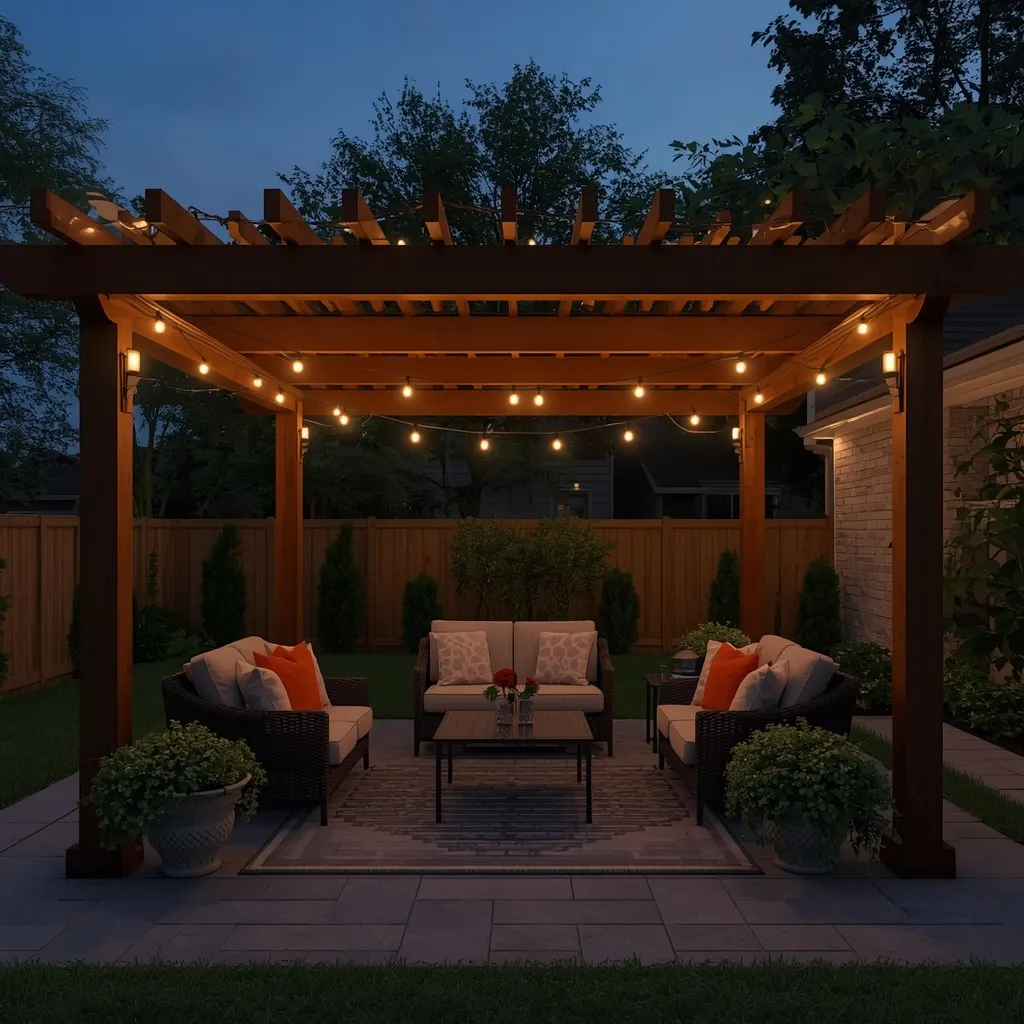
Hanging String Lights Without Drilling Into Anything
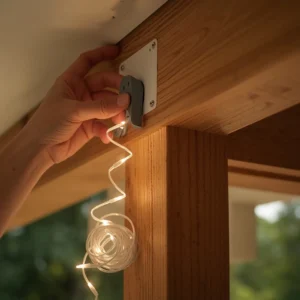
Yes, you can hang string lights without drilling into your walls, siding, brick or fence; no permanent damage required at all. Clip-on hooks, adhesive mounts and tension-based no-drill systems grip existing structures instead of your walls, so a full patio string can go up in well under an hour with zero visible holes left behind.
Key Takeaways
- Adhesive hooks rated for outdoor use hold up to 5-7 lbs each without wall damage.
- Gutter clips are the fastest option for roof lines and eaves, no tools needed.
- Tension rods work well for narrow gaps like railings or pergola beams
- A standard 25-foot no-drill setup costs under $20 in hardware
- Correct removal leaves zero holes, residue or paint damage behind
This guide covers five no-drill methods for the exact scenario you’re working with, plus four related no-drill projects homeowners search for most, from shade sails to heavy wall decor. Keep reading now to find the exact no-drill setup that matches your balcony, patio or brick wall.
Five No-Drill Projects Worth Knowing
Drilling is not the only way to hang something securely outdoors. Adhesive strength, clip tension and dead weight all do the same job without a single hole in your wall. The five guides below cover string lights without drilling and four related no-drill projects, starting with the lights themselves.
Mounting a Shade Sail on an Apartment Balcony
A shade sail needs two or three strong anchor points and a balcony railing or ceiling joist usually provides enough strength without touching the wall itself. Rated eye-bolt clamps that grip the railing tube, rather than piercing it, hold most residential sail sizes in normal wind conditions.
According to Royal Shade USA, a 12-by-12-foot shade sail in a 40 mph wind can generate over 200 pounds of force on its anchor points, which is why every clamp and eye-bolt needs a rating well beyond the sail’s resting weight alone. The table below details the official wind-force guidance established by Royal Shade USA’s installation team.
| Number & Insight | Source (Institute) | Expert / Team |
|---|---|---|
| A 12-by-12-foot shade sail in a 40 mph wind can generate over 200 pounds of force on its anchor points, far exceeding the sail’s resting weight. | Royal Shade USA | Royal Shade Installation Engineering Team |
A properly tensioned sail resists wind far better than a loose one. Push the center from below; if it gives more than four inches, the tension needs adjusting before the next storm. Our full guide on how to mount a shade sail on an apartment balcony covers anchor spacing and tension checks in detail.
Attaching a Trellis to a Brick Wall Without Drilling
Mortar-joint clips grip the raised lip between bricks using spring tension, not adhesive, which keeps the brick face completely untouched. According to the Brick Industry Association, fasteners that rely on friction against the mortar joint rather than penetrating the brick unit itself avoid the risk of cracking the brick face that drilled anchors can cause. The table below details the official fastener guidance established by the Brick Industry Association.
| Number & Insight | Source (Institute) | Expert / Team |
|---|---|---|
| Fasteners that grip the mortar joint through friction rather than penetrating the brick unit avoid the face-cracking risk associated with drilled masonry anchors. | Brick Industry Association | BIA Technical Notes Committee |
Mortar clips typically hold only a few pounds each, so a lightweight trellis needs several clips spaced evenly along the frame. Our full guide on how to attach a trellis to a brick wall without drilling covers spacing and weight limits for different trellis styles.
Hanging String Lights Without Any Drilling
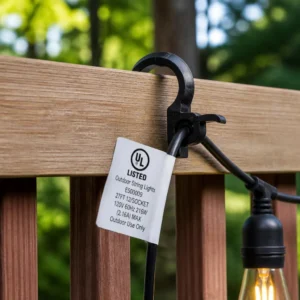
Outdoor string lights need a UL or ETL safety listing specifically for outdoor use, not just an indoor-rated set repurposed for the patio. According to the National Fire Protection Association, outdoor electrical installations, including exterior string lights, need GFCI protection at the outlet, plus lights specifically UL-rated for outdoor use rather than an indoor-only set. That makes the safety listing far more important than the mounting method itself. The table below details the official lighting-safety guidance established by the Consumer Product Safety Commission.
| Number & Insight | Source (Institute) | Expert / Team |
|---|---|---|
| Outdoor electrical installations, including exterior string lights, require GFCI protection at the outlet, along with lights specifically UL-rated for outdoor use rather than an indoor-only set. | National Fire Protection Association | NFPA Electrical Safety Team |
Once the lights themselves are outdoor-rated, adhesive clip hooks spaced every two to three feet along the run carry the weight without strain on any single point. Command-style outdoor hooks, rated specifically for exterior use, resist temperature swings that indoor versions cannot handle.
Anchoring a Patio Gazebo on Concrete Without Drilling
Weighted leg bases replace drilled bolts entirely, using dead weight instead of mechanical fasteners to resist wind. Manufacturer guidance commonly published across the gazebo industry recommends roughly 30 pounds of weight per leg, totaling around 200 pounds across a standard 10-by-10 frame, as the baseline for meaningful wind resistance.
According to a Consumer Product Safety Commission recall notice, one gazebo model’s roof panels came loose in high winds in at least 137 documented incidents, a hazard tied directly to insufficient anchoring rather than any flaw in the fabric or frame itself. The table below details the official wind-hazard data established by the Consumer Product Safety Commission.
| Number & Insight | Source (Institute) | Expert / Team |
|---|---|---|
| A CPSC recall documented at least 137 incidents of gazebo roof panels dislodging in high winds, a hazard directly tied to inadequate anchoring rather than a manufacturing defect in the panels themselves. | U.S. Consumer Product Safety Commission | CPSC Office of Compliance |
Sandbags and filled planters both work and distributing weight evenly across all four legs matters more than concentrating it on one or two. Our full guide on how to anchor a patio gazebo on concrete without drilling covers weight calculations for larger and taller gazebo frames.
Hanging Heavy Wall Decor on Vinyl Siding
Vinyl siding hooks slide under the panel’s lap edge and grip the structure behind it, never puncturing the vinyl face itself. According to the Vinyl Siding Institute, vinyl panels are engineered to expand and contract with temperature changes. That is why any fastener driven directly through the panel face risks cracking as the material shifts seasonally. The table below details the official panel-movement guidance established by the Vinyl Siding Institute.
| Number & Insight | Source (Institute) | Expert / Team |
|---|---|---|
| Vinyl siding panels are engineered to expand and contract with temperature changes, which is why fasteners driven directly through the panel face risk cracking as the material shifts seasonally. | Vinyl Siding Institute | VSI Installation Standards Program |
Standard siding hooks hold roughly 5 pounds, while heavier-duty steel hooks rated for siding use can hold closer to 12 pounds. Our full guide on how to hang heavy wall decor on vinyl siding covers which hook style matches which item weight.
How Much Does It Cost to Hang String Lights Without Drilling (Under $25)
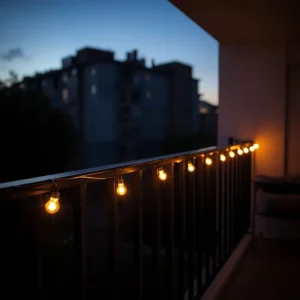
A full no-drill setup for a standard 25-foot string typically costs under $25, covering adhesive hooks or gutter clips and the light string itself if not already owned. Larger patios needing 50 feet or more of coverage usually land between $35 and $50 once enough hooks are purchased to support the full run.
Professional installation services, when homeowners hire out the job entirely, generally charge $75 to $150 depending on patio size and mounting complexity. For a project this straightforward, the DIY route saves significant money without sacrificing a secure, damage-free result.
How Many Adhesive Hooks You Need Per 25 Feet of Lights (7 Hooks)
Spacing hooks every three to four feet along a 25-foot run generally works out to about seven hooks total, which keeps the string from sagging low enough to catch wind or brush against furniture. Corners and any sharp direction change need an extra hook regardless of the straight-line spacing.
Heavier bulb-style string lights need closer spacing than lightweight fairy lights, sometimes closer to every two feet, since the added weight per foot increases strain on each mounting point.
How Long Do No-Drill Light Mounts Last Outdoors (9 Months Average)
Quality adhesive hooks rated for outdoor use typically hold for about nine months before the adhesive bond starts to weaken from UV exposure and temperature cycling. Gutter clips and tension-based mounts, which do not rely on adhesive at all, generally last several years with no meaningful degradation.
Removing and reapplying adhesive hooks at the start of each new season, rather than leaving the same hooks up year-round, extends their reliable holding power considerably.
Conclusion
String lights without drilling are often the sturdier choice, since a clip or tension system spreads strain evenly instead of concentrating it in a few drilled holes. Match the method to your surface, brick, vinyl, concrete or open air and it holds through a full season with nothing left behind.
Once your outdoor lighting is handled, our guide on how to fix faded plastic patio furniture covers five more patio problems worth tackling. Try one of these methods this weekend, then tell us how it held up or share this guide with a friend who thinks drilling is the only option.
Frequently Asked Questions (FAQs)
How do you hang string lights without drilling?
You hang string lights without drilling by using adhesive hooks rated for outdoor use, gutter clips along roof lines or tension rods across narrow gaps, spacing the mounting points every two to three feet so no single hook bears too much of the string’s weight.
Will Command hooks hold outdoor string lights?
Command hooks rated specifically for outdoor use hold most standard string light setups, typically up to 5 to 7 pounds per hook, though indoor-only Command hooks will fail faster outdoors due to temperature swings and UV exposure.
Do adhesive hooks damage paint when removed?
Adhesive hooks designed for clean removal will not damage paint if removed slowly and at the angle specified on the packaging, though rushing the removal or pulling straight out instead of sideways can pull paint away with the adhesive strip.
Can you hang string lights on a fence without drilling?
You can hang string lights on a fence without drilling using screw-in cup hooks that thread into the wood without a pilot hole or adhesive hooks on vinyl and composite fencing, both of which avoid the splitting risk that nailing can cause.
How much weight can outdoor adhesive hooks hold?
Outdoor-rated adhesive hooks generally hold between 5 and 7 pounds each, though the exact rating depends on the brand and the surface texture, with smooth painted surfaces holding closer to the packaging’s stated maximum than rough or textured ones.