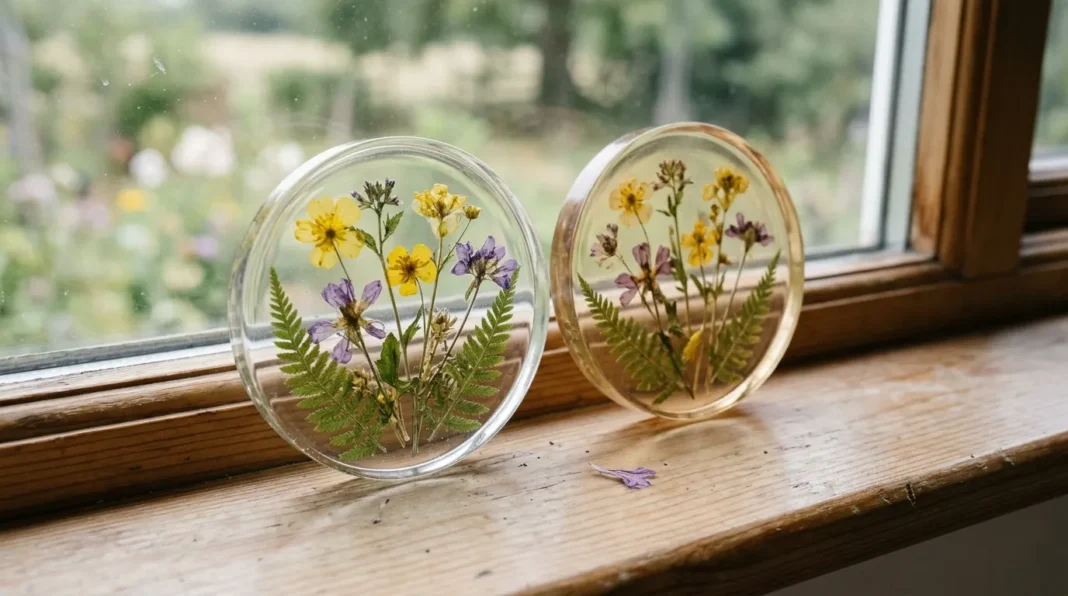

Why Clear Resin Yellow Flowers And The 3 Best Fixes
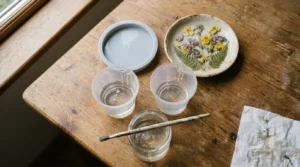

Clear resin yellow flowers when UV light and heat slowly break down the epoxy itself, not because the petals underneath are rotting or fading on their own. Three fixes stop most of it: a UV-stabilized resin that names its additives on the label, flowers that are fully dry and sealed before the pour and a thin, cool cure kept well away from direct sun.
Key Takeaways:
- UV light and heat age the epoxy. The flowers are innocent.
- In one lab test, epoxy with no UV absorber yellowed visibly after 500 hours of strong UVB light. A 3% absorber kept yellowing faint even at 800 hours.
- Brown or cloudy petals usually mean trapped moisture, not yellowing. Dry and seal every flower first.
- Thin layers stay cooler while they cure. Thick pours trap heat.
- Yellowing that has formed inside the resin is permanent. Prevention is the only real fix.
Every craft in this guide fails for one fixable reason. Resin yellows in light. Chalk paint softens in heat. Twisted cord spins open under the weight of a pot. Wet leaves brown behind glass. Cement goes heavy when the mix is off. The resin guide sits in the middle because it gets the full treatment, so start there if a piece of yours is already turning amber.
Five Craft Skills That Keep Resin And Botanical Projects Looking New
Stopping clear resin yellow flowers gets most of the attention. The work around the resin decides whether a project lasts. A pressed leaf that was never dried properly will brown. A painted jar sealed too early will peel. A hanger built from twisted cord will spin. Each problem looks small until the finished piece starts to fail on a shelf or in a window.
The five guides run in the order most crafters hit them. Resin sits in the middle because it is the one covered in full here. The other four are short previews with a complete guide behind each, so you can read the quick answer first and follow the link only when that problem is yours. Every guide carries one table of numbers so the advice does not rest on opinion alone.
Pressing Leaves For Wall Art In Minutes Instead Of Weeks
Pressing leaves the slow way means a heavy book and weeks of waiting. A microwave and some silica gel cut that to minutes. Moisture is the thing to control. Leaves pressed while damp turn brown and can grow mold behind glass. That ruins the wall art you framed. The full method is in how to press leaves for wall art fast in the microwave.
The University of Missouri Extension gives a microwave window for dried flowers: about one minute for small, thin-petaled blooms and up to three for dense ones. Leaves are thin, so start at the short end and check often. Every microwave runs a little differently, and overdone leaves turn brittle. Blot each leaf dry before it goes in. Wet plant matter wrecks resin pours too. The table below details microwave flower-drying guidance established by University of Missouri Extension specialists.
| Number & Insight | Source | Expert/Team |
|---|---|---|
| 1 minute for small, thin-petaled flowers and up to 3 minutes for dense ones when drying in the microwave | University of Missouri Extension, “Garden flowers bloom all year when dried” (checked October 2026) | MU Extension horticulture specialists |
Sealing Chalk Painted Mason Jars So The Finish Lasts
A sealed jar is not a dishwasher jar and most tutorials never say so. Chalk paint dries to a thin matte film on glass. A water-based sealer only protects that film from light handling and dust. Let the paint dry fully before you seal and keep each coat thin. Start with how to seal chalk-painted mason jars for the coat count and cure time.
The Smithsonian Museum Conservation Institute’s care notes for acrylic paint say it dries in under thirty minutes and softens around 60 °C. That’s about 140 °F. Dry to the touch is not cured all the way through, so give the jar extra time before you stack or handle it. Many chalk paints are acrylic-based, so keep decorated jars away from hot water and heaters. The table below details acrylic paint heat and drying guidance established by Smithsonian Museum Conservation Institute specialists.
| Number & Insight | Source | Expert/Team |
|---|---|---|
| Acrylic paint softens around 60 °C (about 140 °F) | Smithsonian Museum Conservation Institute, “Caring for Acrylic Paintings” (checked October 2026) | Smithsonian MCI conservators |
| Acrylic paint dries in under 30 minutes, though drying is not the same as full curing. | Smithsonian Museum Conservation Institute, “Caring for Acrylic Paintings” (checked October 2026) | Smithsonian MCI conservators |
Stopping Clear Resin Yellow Flowers Before They Start
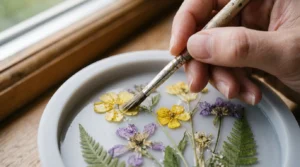
A 2017 lab study of UV-aged clear epoxy, hosted by the National Institutes of Health, exposed a clear epoxy to strong UVB light. Epoxy with no UV absorber yellowed visibly at 500 hours and looked worst at 800. With 3% UV absorber, it stayed faint at 800. The lamp sat only 5 cm from the samples, so a sunny windowsill is far gentler. Read the numbers as a direction and not a calendar. The table below details clear epoxy UV-aging findings published in Materials by researchers at Deakin University and partner institutions.
| Number & Insight | Source | Expert/Team |
|---|---|---|
| 500 hours of strong UVB light: visible yellowing in epoxy with no UV absorber and most severe at 800 hours | Nikafshar et al., Materials 2017, hosted on PubMed Central (checked October 2026) | Nikafshar, Zabihi, Naebe et al. |
| 3% UV absorber added: only low-intensity yellowing that appeared at 800 hours | Nikafshar et al., Materials 2017, hosted on PubMed Central (checked October 2026) | Nikafshar, Zabihi, Naebe et al. |
| Visible-range absorbance area (a yellowing measure) rose from 32.9 to 64.94 without the absorber and from 33.53 to 36.55 with it. | Nikafshar et al., Materials 2017, hosted on PubMed Central (checked October 2026) | Nikafshar, Zabihi, Naebe et al. |
| Surface cracks appeared after 500 hours without the absorber and at no point with it. | Nikafshar et al., Materials 2017, hosted on PubMed Central (checked October 2026) | Nikafshar, Zabihi, Naebe et al. |
Fix 1: buy a resin that names its UV absorber or HALS (hindered amine light stabilizers) on the label. Fix 2: dry the flowers fully and seal them with a thin coat before the pour so trapped moisture cannot brown the petals. Fix 3: pour thin and keep the cure cool because exothermic heat builds fast in thick layers. Then hang the finished piece away from direct window light.
Fixing Twisted Macrame Plant Hanger Cords Before They Spin
Your hanger spins and the cords corkscrew. Both come from twist stored in the cord, now free to unwind under a pot’s weight. Check what you bought first because twisted cord and braided cord fail differently. Braided cord holds its shape far better. Three-strand twisted cord is the one that spins. For twisted cord, start with how to fix twisted macrame plant hangers.
University of Alaska Fairbanks Sea Grant explains how three-strand twisted rope stays balanced. The strands lay clockwise while the yarns run counterclockwise and the fibers clockwise. That opposing twist holds it together, so coil clockwise and uncoil counterclockwise. Fight that direction and you add kinks. Look at the cord before you cut your lengths and note which way the strands run. The advice is for boat rope but twisted cord works the same way. The table below details twisted rope lay and coiling guidance established by University of Alaska Fairbanks Sea Grant specialists.
| Number & Insight | Source | Expert/Team |
|---|---|---|
| 3 strands laid clockwise (right-hand lay) with the yarns twisted counterclockwise and the fibers clockwise | University of Alaska Fairbanks Sea Grant, Boatkeeper, “Rope for Ordinary Vessel Use” (checked October 2026) | Terry Johnson, UAF Marine Advisory Program |
| Coil twisted rope clockwise and uncoil it counterclockwise | University of Alaska Fairbanks Sea Grant, Boatkeeper, “Rope for Ordinary Vessel Use” (checked October 2026) | Terry Johnson, UAF Marine Advisory Program |
Making Quick Dry Cement Pots That Don’t Weigh A Ton
2 parts cement. 3 parts coir. 3 parts perlite. That’s a real lightweight planter recipe from a university extension service with no sand in it. Rapid-set cement sets faster than regular Portland cement, so you get less working time to shape the pot. That changes how you mix and mold. Read how to keep quick-dry cement pots light enough to carry before you mix a bucket.
Oregon State University Extension gives the mix by volume, so measure with a bucket and not by eye. Sand adds weight and perlite and coir take it out. A pot built this way is far lighter than stone but less tough, so handle it gently. Wear gloves while you mix because wet cement is caustic and irritates bare skin. Rinse your tools right away before the mix hardens on them. The table below details lightweight planter mix guidance established by Oregon State University Extension specialists.
| Number & Insight | Source | Expert/Team |
|---|---|---|
| 2 parts Portland cement to 3 parts coir to 3 parts perlite, measured by volume in a bucket | Oregon State University Extension, “Craft stone-look planters with hypertufa” (checked October 2026) | Linda R. McMahan, OSU Extension |
3 Mistakes To Avoid When Casting Dried Flowers In Resin
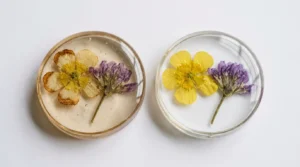
Wet flowers are mistake one and even petals that feel dry pick up moisture from the air. Water trapped against a petal browns it and leaves a cloudy halo in the cured resin. That halo is often blamed on the resin when the flower caused it. Dry the flowers fully and seal them with a thin coat before you pour. Skipping this step is an easy way to ruin a good pour.
Mistake two is one thick pour. Heat builds as it cures and trapped air has nowhere to go. Mistake three is eyeballing the mix. Resin and hardener must go in at the exact ratio on the label. Get it wrong and the cure turns soft or sticky and no amount of waiting fixes it. Measure both parts every time and write the ratio on the lid of your bottle so you never have to guess.
5 Best Ways To Check If A Resin Is Really UV Resistant
Read the label first. A real stabilized resin names its UV absorber or HALS. “UV resistant” on its own tells you nothing because any brand can print it. Then check the hardener bottle. Hardener that has already turned amber in storage often gives a tinted cast from day one, so buy fresh stock from a seller that turns it over and look for a batch date if one is printed.
Ask the maker for yellowing test data since honest brands have some. Then run your own test. Cast two small coins from the same batch and put one on a sunny sill and one in a drawer for four weeks. Compare both on white paper in daylight. Any visible difference is your answer and it cost you two coins. Keep them as your reference when you try a new brand.
3 Proven Ways To Rescue Resin Flowers From Ugly Yellow Tint
Be honest first. Yellowing that runs deep in the resin is permanent and polishing only fixes scratches. If the tint sits near the surface, a light wet-sanding and a fresh topcoat of UV-stable resin can brighten it. Test on a spare piece before you touch the real one. Sanding a good piece into a worse one is the usual way rescues fail. That is way one.
Way two is to hide the tint. Move the piece out of direct light and pair it with warm tones and wood so the amber looks chosen. Way three is to recast. A small pendant is cheap to redo with stabilized resin. A large tabletop is a bigger loss, so protect that one with stabilizer and shade from the very first pour.
Clear Resin Stays Clear When You Block The Light
Resin yellows because light and heat keep working on it long after the cure is done. A UV-stable resin, dry sealed flowers and a thin, cool pour remove most of that damage before it starts. Clear resin yellow flowers fastest in sunny windows, so a stabilizer and a shady shelf do the real work. Everything else here is really just detail around that one simple habit.
The same habit carries over to the rest of this guide. Dry the leaves. Seal the jar. Check the twist in your cord. Weigh the cement by volume. For another easy garden craft, try how to plant seed paper craft for wildflowers next. Did this save a piece you nearly lost? Tell us in the comments and share it with a friend or family member.
Frequently Asked Questions (FAQs)
Why does clear resin yellow flowers over time?
Clear resin yellow flowers because UV light and heat slowly break down the cured epoxy. The color shifts toward amber and the flowers inside look yellow with it, even though the petals are unchanged. Sunlight, warm rooms and thick hot pours speed it up. A UV-stabilized resin, sealed flowers and a spot away from direct sun slow it down.
Can you stop clear resin from turning yellow after it cures?
No. Yellowing that has formed inside cured resin is permanent and polishing only fixes surface scratches. You can slow further change by keeping the piece out of direct sun and away from heat. For the next pour, choose a resin that names a UV absorber or HALS on the label and cure it in thin layers.
How long does clear epoxy take to turn yellow?
Clear resin yellow flowers at different speeds depending on the resin and how much sun it gets. In one lab study, epoxy with no UV absorber yellowed visibly after 500 hours under strong UVB light. A 3% UV absorber kept yellowing faint even at 800 hours. A sunny windowsill is gentler than that lamp, so real pieces usually take longer.
Do dried flowers turn brown inside resin?
Yes, when moisture is trapped with them. Brown petals are a separate problem from the way clear resin yellow flowers over time. Water in or on a petal browns it and clouds the resin around it. Dry flowers completely and seal them with a thin coat of clear sealer or resin before the main pour.
Does UV resin yellow like epoxy?
Hobby UV-curing resin can also yellow with age and sun exposure. A UV lamp cures it in minutes and does not make it immune to sunlight afterward. Keep finished pieces out of direct light and pick a brand that states its UV stabilizers. Check the label before you buy and skip any bottle that only says UV resistant.