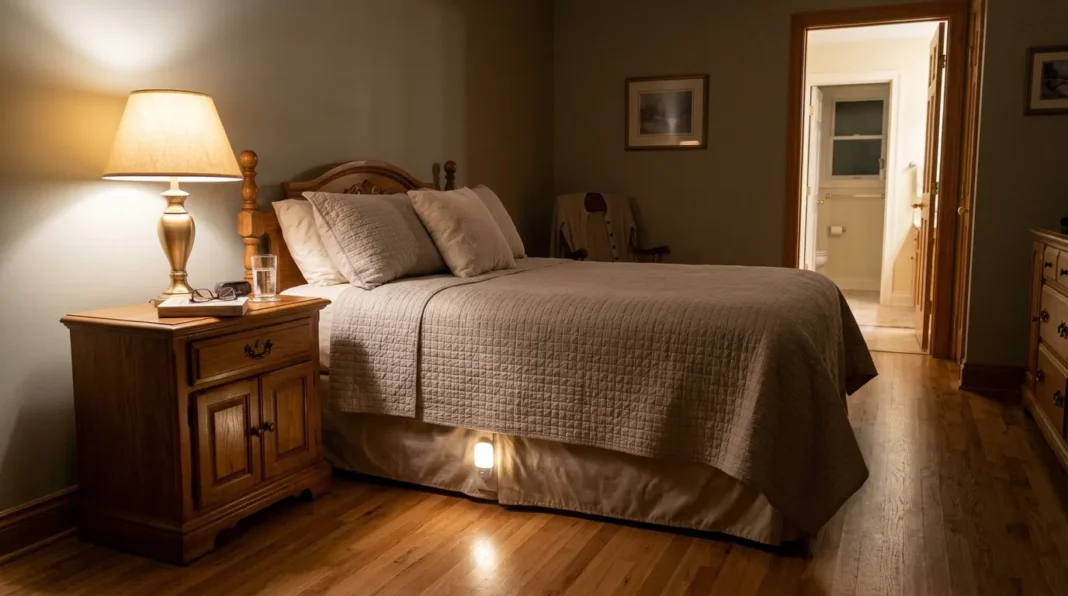

Lighting for Senior Bedroom Safety Starts With Three Layers of Light
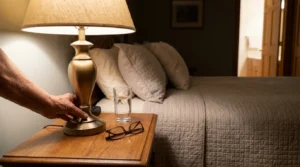

The best lighting for senior bedroom safety is a layered setup: a lamp or night light within reach of the pillow, soft motion-activated lights along the route to the bathroom and bright non-glare bulbs overhead. Aging eyes need far more light than younger ones, so a single dim lamp across the room rarely does the job. Layers fill in the dark gaps that matter most between the bed and the toilet.
KEY TAKEAWAYS:
- Older adults can require 3 to 6 times more light than younger people.
- The darkest spot in a New York City study of seniors’ homes was the bathroom floor.
- A night light or motion-activated light removes the need to find a switch in the dark.
- Bright bulbs help only when they are non-glare, since glare hides steps and edges.
- Keep light levels even from the bedroom to the hall and the bathroom.
Lighting is one of the five fixes in our full plan to modify bedroom for seniors safely, alongside rails, floors, walking paths and bed height. It is also one of the cheapest changes you can make, because most of it plugs into a wall or screws into a socket. The three risks below show where bedroom lighting usually goes wrong and how to fix each one without rewiring a thing.
3 Lighting Risks to Avoid in a Senior Bedroom
When you plan lighting for senior bedroom spaces, remember that a room that feels perfectly comfortable at noon can hide real hazards after dark, when eyes adjust slowly and the path to the bathroom runs through shadow. Each risk below explains what goes wrong and what to change. The fixes work for any sleeper whose eyesight has changed with age, whether the room is a spare bedroom, a downsized apartment or a parent’s long-time home.
Relying on One Dim Lamp
One lamp in one corner feels like enough for most lighting for senior bedroom plans, yet it leaves the rest of the room and the hallway in half light. A 2021 study in the American Journal of Ophthalmology followed 170 people with glaucoma or suspected glaucoma for three years. Their hallways, bedrooms and stairs were the areas least likely to meet the recommended minimum of about 30 footcandles (323 lux), according to Review of Optometry’s summary of the work.
The same study found that for each tenfold increase in room lighting, falls in that area dropped by 35 percent. A tenfold jump means going from a dim 30 lux to about 300 lux, which is why bulb strength and number of light sources both matter. Keep in mind the participants had glaucoma, so treat the figure as a strong signal rather than a promise for every sleeper.
Skipping a Lit Path to the Bathroom
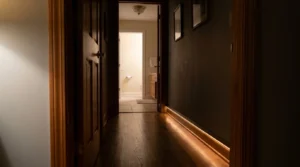
The trip to the bathroom is the most common night-time journey. It is often the darkest. In a New York City study of seniors’ homes, the darkest area was the bathroom floor. Nearly 50 percent of falls happened in bathrooms. The National Council on Aging advises a night light so the path to the bathroom stays visible, plus motion-activated or sound-activated lights so nobody has to hunt for a switch.
The Lighthouse Guild’s vision-friendly living environments guide adds that lighting levels should be uniform from room to room, so eyes do not face a sudden dark patch at the bedroom door. Walk the route yourself after dark with your eyes half shut. Any stretch where you cannot see the floor needs a light, whether that is a plug-in night light at ankle height or a motion strip along the wall. The table below details nighttime lighting guidelines established by Lighthouse Guild specialists.
| Insight | Source | Team |
|---|---|---|
| Lighthouse Guild reports that the darkest area in a New York City study of seniors’ homes was the bathroom floor and that almost 50 percent of falls occur in bathrooms. It advises lighting levels that are uniform from room to room, with stairs and halls well lit. | Lighthouse Guild | Lighthouse Guild Editorial Team |
Letting Glare and Low Contrast Hide the Edges
Brighter is not always better. A bare bulb or a glossy floor can throw glare that hides steps and thresholds. The Lighthouse Guild advises non-skid floor wax over high-gloss wax for exactly this reason. NCOA similarly recommends replacing dim bulbs with bright, non-glare bulbs, so choose frosted or shaded fixtures that spread light softly instead of aiming a hot spot at the eyes.
Contrast matters as much as brightness. Lighthouse Guild suggests painting doors, floor molding and handrails a contrasting color so they stand out. It also suggests choosing solid flooring and rugs instead of busy patterns that can confuse the eye. Light the top and bottom of any stairs. Keep a flashlight on the nightstand for power cuts. These small touches help an older eye read the room at a glance.
3 Signs Your Bedroom Lighting Is Too Weak
Your bedroom lighting is likely too weak when you have to squint to read a medicine label at the bedside, when the floor between the bed and the door disappears into shadow or when a light switch sits across the room instead of within reach of the pillow. Any one of these signs means the room needs another light source, not simply a stronger bulb in the same spot.
Another warning sign is a sudden change between rooms. If the hallway looks dark after the bedroom or the bathroom looks harsh after the hallway, eyes must adjust at every doorway. Even lighting from room to room, as Lighthouse Guild recommends, lets the person walk through without pausing to see, which is when most missteps happen. Check each doorway on your route. Note any spot where the light drops sharply.
5 Low-Cost Lighting Fixes to Try Tonight
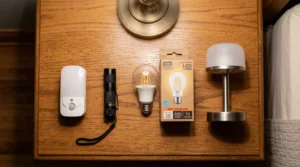
Five simple fixes cover most bedrooms: a plug-in night light along the path to the bathroom, a motion-activated light near the bed, brighter non-glare bulbs in existing lamps, a lamp or touch switch within reach of the pillow and a flashlight on the nightstand. NCOA lists most of these ideas. None of them needs an electrician or any change to the walls.
Start with the route to the bathroom, since that is where the biggest gains sit. Place the first light low near the floor. Put the second near the door so the person sees both the path and the doorway. Replace any bulb that feels dim, then test the room at night to confirm that every step of the route is clear before the next evening arrives.
Best Lighting for Senior Bedroom Layout in 2026 (Editor’s Pick)
The strongest 2026 layout uses three layers. A bedside lamp or touch light sits within reach of the pillow, motion-activated lights follow the path to the bathroom and a soft overhead fixture with non-glare bulbs lights the room evenly. Lighthouse Guild also recommends mixing natural light, overhead lighting, floor lamps and adjustable table lamps, so add a task lamp wherever the person reads or sorts medication.
This layout works for most older adults because it covers three needs at once: finding the way, seeing the floor and avoiding glare. If budget is tight, begin with the night path and the bedside light, then add the overhead upgrade later. Pair it with a clear floor and a bed at the right height. The room then becomes far easier to leave safely in the dark.
A Bedroom You Can Cross With Your Eyes Half Shut
Walk the route from the pillow to the bathroom tonight and mark every dark stretch with a night light or a motion-activated light. Then upgrade the bulbs so they are bright but non-glare. Keep a lamp within reach of the bed. Those three changes fix most of the lighting problems described above. They take less than an hour. Lighting for senior bedroom safety rarely needs more than that.
The reason it matters is plain: the CDC reports that more than one out of four older people falls every year. In the glaucoma study above, the bedroom was where 20 percent of the recorded falls happened. A well-lit room also lets a person keep doing what they have always done, with fewer hidden dangers in the dark. Try the half-shut-eyes test again this week, then tell us which spot surprised you most.
Frequently Asked Questions (FAQs)
Which lighting is best for a senior bedroom?
The best lighting for senior bedroom use is layered: a bedside lamp or night light within reach, motion-activated lights along the path to the bathroom and bright non-glare bulbs overhead. This setup covers finding the way, seeing the floor and avoiding glare.
How much light do seniors need in a bedroom?
Lighthouse Guild says seniors can require 3 to 6 times more light than younger people. A glaucoma study summarized by Review of Optometry cited a recommended minimum of about 30 footcandles (323 lux) in the home.
Should a senior bedroom have a night light?
Yes. NCOA advises a night light so the path to the bathroom is visible. Lighthouse Guild notes that more than half of participants in a New York City study did not use a night light or turn on a light when getting out of bed.
Are motion-activated lights good for seniors?
They are a strong choice because nobody has to find a switch in the dark. NCOA suggests motion-activated or sound-activated lights for bedroom and bathroom paths.
What bulbs are best for older eyes?
Lighthouse Guild recommends higher-wattage, compact fluorescent or LED bulbs and testing light levels to find what works. NCOA adds that bulbs should be bright but non-glare.