
Self Watering Vertical Planters Explained
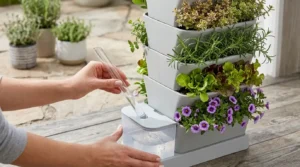

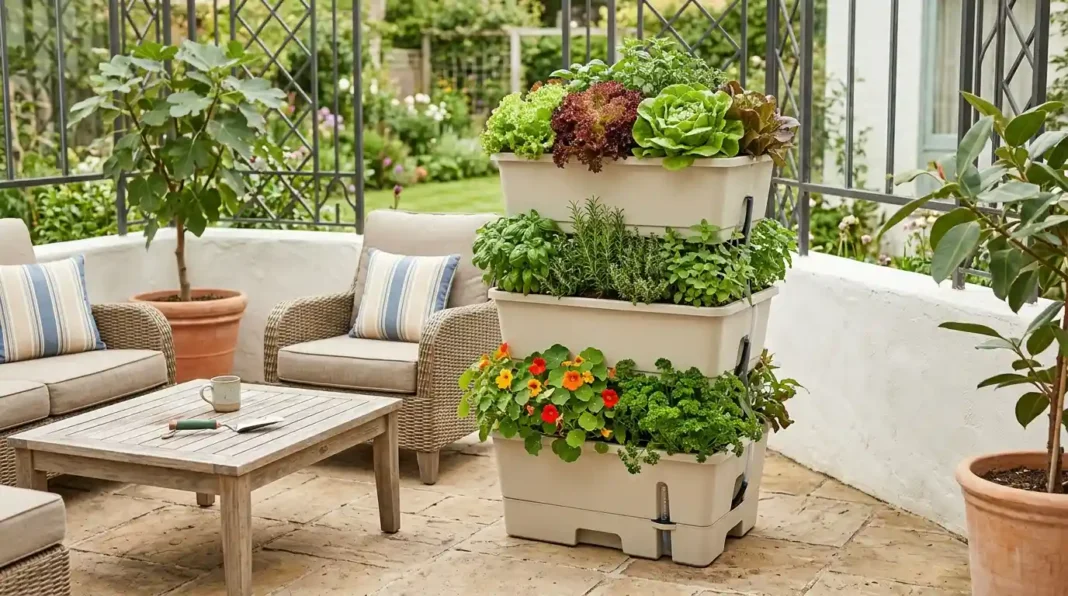
Self watering vertical planters are stacked planting columns with a built-in water reservoir at the base. Water travels up into each tier through capillary action, not a pump or timer. That’s the whole mechanism. A patio corner that couldn’t fit a raised bed can hold a five-tier column instead. The footprint stays under 2 square feet. The growing area stacks upward instead of out. Herbs, lettuce and strawberries all do well in this format, and most owners check the reservoir once every few days rather than watering by hand each morning.
Key Takeaways
- A reservoir at the base waters every tier without daily attention.
- Capillary action pulls water up roughly 4 inches above the water table.
- Most owners refill every 4 to 7 days once plants are established.
- A vertical column fits where a full raised bed can’t.
- Basic plastic kits start under $40; ceramic and wood versions cost more.
This guide covers reservoir sizing, tier count, material choice, refill timing and the build mistake that causes most root rot complaints.
Five Self Watering Vertical Planter Guides
Self watering vertical planters range from a simple two-tier plastic column to a five-tier ceramic tower. But the reservoir design underneath matters more than how many pots sit on top. The five guides below walk through the build and care decisions in the order they actually come up, starting with how the reservoir itself works.
How the Water Reservoir Actually Works
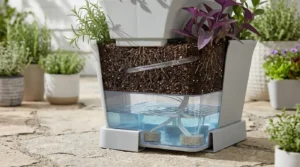
A sealed reservoir sits at the base of the column, usually holding 1 to 3 gallons depending on size. The University of Kentucky Cooperative Extension explains the physics behind it clearly. Capillary action can move water up roughly 4 inches above the water table on its own. No pump required. That’s why most vertical planter reservoirs stay shallow. Water only needs to travel a short distance before gravity and soil density start working against it. The table below shows the capillary-action numbers from the University of Kentucky Cooperative Extension.
| Number & Insight | Source (Institute) | Expert / Team |
|---|---|---|
| Capillary action can move water up approximately 4 inches above the water table, and established beds typically need refilling every 4 to 7 days without rain. | University of Kentucky Cooperative Extension | UK Biosystems and Agricultural Engineering |
That 4-inch limit is why taller vertical planters split into separate stacked reservoirs instead of one tall column of water. Read more from UK Extension’s wicking bed guidance before sizing a reservoir for a tall column.
Choosing Two Tiers or Five
Two tiers keeps the whole unit under 24 inches tall. That’s light enough to move on a windy patio without tipping. Five tiers pushes total height past 4 feet, which means real weight once every tier is planted and watered. A full 5-tier ceramic column can weigh over 80 pounds loaded, so check what the patio surface underneath can actually hold before stacking that high.
Herbs and lettuce do fine in a 2 or 3-tier column, since their roots stay shallow. Tomatoes and peppers need real root depth, which usually means skipping the top tier of a tall column and using only the bottom two.
Plastic, Ceramic or Wood: What Each Material Costs You
Plastic is the cheapest and lightest option. Most basic kits run $25 to $40 for a 3-tier column. It also fades and gets brittle after two or three seasons in direct sun. Ceramic holds up far longer and looks better on a visible patio. A comparable 3-tier ceramic column often runs $80 to $150. It also cracks if water freezes solid inside an unemptied reservoir over winter.
Wood-framed versions split the difference on price, usually $50 to $90. They need a plastic or rubber liner inside to hold the reservoir. Untreated wood alone won’t hold water on its own. Skipping that liner is the single most common reason a wood vertical planter fails within its first year.
Refilling on a Schedule vs. Refilling by Feel
Most owners refill every 4 to 7 days once plants are established, per UK Extension’s guidance, but that number shifts fast with weather. A hot, windy week can empty a reservoir in half that time. Check the water level gauge or dip a finger into the fill tube before assuming the schedule still holds. An empty reservoir defeats the entire point of the system, since the plants have no backup water source once it runs dry.
Leave about an inch of space at the top of the reservoir rather than filling it completely. A full reservoir right before a heavy rain just pushes excess water out the overflow, wasting both the water and any dissolved fertilizer in it.
The One Mistake That Causes Root Rot
Planting media matters as much as the reservoir design. A heavy, dense potting mix holds too much water against the roots, since it can’t wick moisture back down when the reservoir level drops. That trapped moisture is the most common cause of root rot complaints in vertical planters, not overwatering itself.
Use a mix that’s at least a third perlite, coarse sand or a similar drainage additive, not straight garden soil or heavy potting mix. That keeps air pockets in the root zone even when the reservoir below is full.
The 4-Inch Capillary Limit Explained
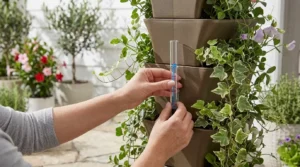
Water can only wick up about 4 inches above the reservoir’s water line before gravity wins. That’s a hard physical limit, not a product design choice. It’s why every legitimate self watering planter uses a shallow, wide reservoir rather than one deep pool of water. A taller column needs multiple stacked reservoirs, one per tier, to cover the same total height.
Any product claiming a single reservoir waters a 4-foot column evenly from one water source is stretching that physics. Check whether a tall column actually has separate fill points for each tier before buying.
1 Liner Fix for a Cracked Wood Planter Base
A cracked or leaking reservoir liner is the most common repair on a wood-framed vertical planter, and it’s a cheap fix. A sheet of pond liner or heavy-duty rubber roofing membrane works as a replacement. Cut it to fit, then seal the seams with aquarium-safe silicone. Most repairs cost under $20.
Let the silicone cure fully, usually 24 hours, before refilling the reservoir. Rushing this step is why a repaired liner often fails again within weeks.
Best Budget Self Watering Planter Under $40: 2026 Pick
A basic 3-tier plastic kit is the clearest way to land a self watering vertical planter under $40 this year. Expect a single reservoir base with three stacked pots, not a taller ceramic or wood-framed build at that price.
Ceramic and wood versions start closer to $70 to $80 even at the smallest sizes, since the materials and liners cost more to produce. If budget is the main driver, plastic remains the practical choice, even though it won’t last as many seasons.
Self Watering Vertical Planter Buying Takeaways
A self watering vertical planter earns its spot on a small patio by solving a space problem, not just a watering problem. Two or three tiers suits most apartment balconies, while five tiers needs a sturdy surface and shallow-rooted plants. The reservoir’s 4-inch capillary limit is the real design constraint behind every version on the market, plastic, ceramic or wood. Get the soil mix right before anything else, since a dense potting mix is really what actually causes most root rot complaints, not the watering system itself.
Check the reservoir every few days rather than trusting a fixed schedule, and empty it before a hard freeze if you’re using a ceramic version. If you’re weighing this against a full elevated bed on legs instead, our guide on what are elevated raised garden beds breaks down that larger build. If this guide helped you plan your build, let us know in the comments below and share it with friends or family who are setting up their own garden beds this season.
Frequently Asked Questions (FAQs)
What is the best self watering vertical garden planter for a patio?
The best self watering vertical garden planter for a patio is a 2 or 3-tier plastic or ceramic column with a sealed base reservoir. That size stays light enough for a small patio while still cutting daily watering down to a check every few days.
How often do you refill a self watering vertical planter?
Most established plantings need a refill every 4 to 7 days, according to University of Kentucky Extension research. Hot or windy weather can shorten that to every 2 to 3 days.
Can self watering vertical planters cause root rot?
Yes, if the soil mix is too dense. A heavy potting mix traps water against the roots instead of wicking it back down. That’s the main cause of root rot in these systems, not the reservoir itself.
How tall should a self watering vertical planter be?
Two tiers, under 24 inches, works well for herbs and lettuce with shallow roots. Five tiers, over 4 feet tall, needs a sturdy surface and is better suited to shallow-rooted plants on the upper levels.
Do self watering vertical planters work in winter?
Empty ceramic reservoirs before a hard freeze, since trapped water can crack the material as it expands. Plastic versions tolerate freezing better, but growth slows regardless once temperatures drop.