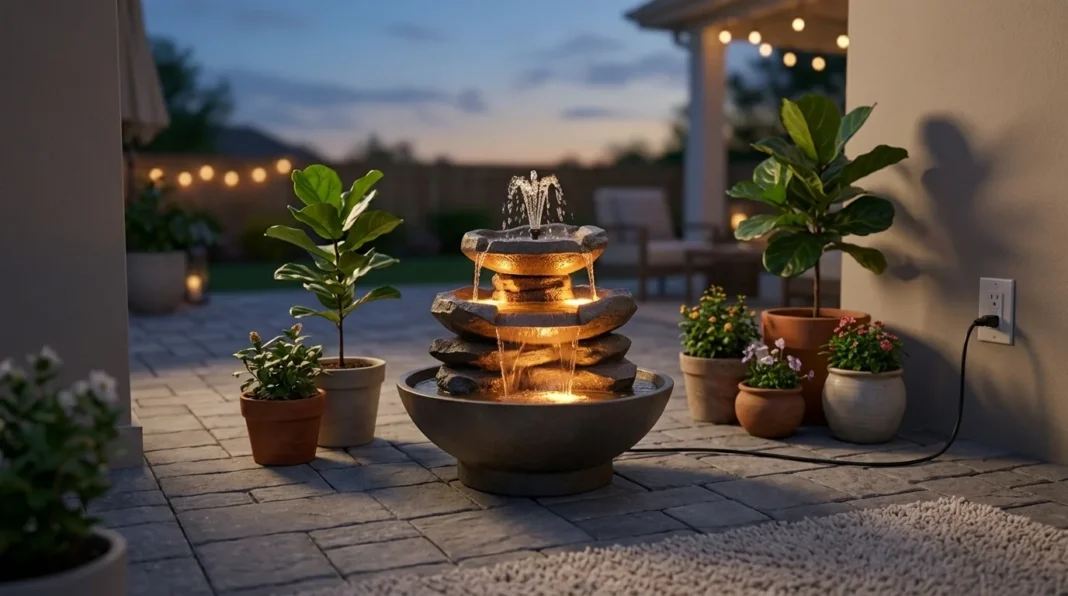

Plug and Play Outdoor Water Fountains Explained

Plug and play outdoor water fountains set up in five steps: level the base, power up safely, place the lights, prime the pump and plan for winter. The U.S. Consumer Product Safety Commission says the National Electrical Code has required GFCI protection on outdoor outlets since 1973 and advises testing each one monthly.
Key Takeaways:
- Plug into a GFCI outlet and test it at least once a month and after any power failure.
- Set the basin on firm and level ground since 5 gallons of water weighs about 42 pounds.
- Shop for lights by lumens and color number, not by watts.
- Prime the pump so trapped air doesn’t stall the spray.
- Drain the basin and store the pump before a hard freeze.
Each step takes minutes and heads off a common failure: a tripped breaker, a tilted basin, a dull light, a pump that hums without spraying. None of it needs special tools. Do the steps in order and the fountain runs all season quietly. Keep reading to set yours up the right way.
Five Steps From Box to Evening Spray
A plug and play outdoor water fountain is a ready-to-run kit that ships with the basin, pump and lights included. It needs only water and power. Some versions run on solar panels instead and skip the outlet. Five jobs cover the setup: the ground under it, the power feeding it, the lights on it, the pump inside it and the weather around it. Each has a quick fix.
Choosing Firm and Level Ground
A full basin is heavy. Water weighs about 8.3 pounds per gallon, so a 5-gallon basin holds roughly 42 pounds before the fountain itself goes on top. Soft or sloping ground makes that weight lean so a tilted basin spills from one side and leaves the pump half dry. Wet soil softens after rain and a small lean grows into a big one.
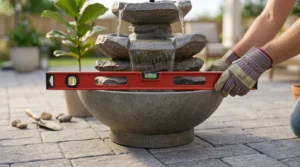
Set a flat paver or a thick slab under the base and check it with a level in two directions. Keep the spot clear of overhanging trees since falling leaves clog the intake. Leave room to reach the pump later. A fountain you can’t reach is a fountain you won’t clean. Test the view from your favorite seat before you fill the basin.
Powering Up Safely
Plug the fountain into a GFCI-protected outdoor outlet. The U.S. Consumer Product Safety Commission says a GFCI watches the current and cuts power faster than a blink of an eye when it senses a leak to ground. The commission also says GFCIs have helped cut electrocutions and that every GFCI needs testing after installation, at least once a month and after a power failure.
No GFCI outlet nearby? A portable GFCI plugs into the receptacle and protects whatever you connect to it. Keep every plug connection off wet ground and use an outdoor-rated extension cord only when you must. Keep the run short. Check it for cracks first. Some plug and play kits run on solar panels instead. Those skip the outlet and need full sun on the panel.
Setting Up the LED Lights

The light ring is the easy part. The U.S. Department of Energy says LEDs are cool to the touch while incandescent bulbs release 90% of their energy as heat. Cool running is a good trait for lights that sit in water. Check that the ring is rated for submersion anyway. Then choose the color since warm and cool white feel very different at night. The table below details LED lighting guidelines established by U.S. Department of Energy specialists.
| Number & Insight | Source (Institute) | Expert / Team |
|---|---|---|
| Incandescent bulbs release 90% of their energy as heat and only 10% as light. LEDs are cool to the touch. | U.S. Department of Energy | DOE Energy Saver (DOE/EE-2465) |
| An LED can last up to four times longer than a CFL. To replace a 75-watt incandescent, look for about 1,100 lumens. | U.S. Department of Energy | DOE Energy Saver (DOE/EE-2465) |
| Color is measured on the Kelvin scale. Lower numbers look warmer. Higher numbers look cooler. | U.S. Department of Energy | DOE Energy Saver (DOE/EE-2465) |
Shop by lumens, not watts. Watts tell you how much power a light draws while lumens tell you how bright it is. If a replacement ring lists only watts, skip it. Ask the seller for the lumen rating in writing if the listing leaves it out. Read the department’s Consumer Guide to Energy-Efficient Lighting before you swap a failed ring for a brighter one.
Priming the Pump and Setting the Spray
Fill the basin and submerge the pump before you switch it on. A pump that runs dry can burn out since it needs water to work. Air trapped in the impeller can also stall the first start. Tilt the pump underwater until the bubbles escape. Top up the basin after the first few minutes since the spray holds some water in the air.
Start the spray low and raise it in small steps. Many plug and play outdoor fountains have a flow dial on the pump body. A tall spray looks great until a breeze throws water out of the basin. Watch the water level for the first hour since splash and evaporation can drop it faster than you expect. Small steps keep the splash zone small.
Planning for Winter
Ice can crack a pump housing and a basin because water expands as it freezes. Unplug the fountain and drain the basin before the first hard freeze. Leave nothing sitting in standing water over winter. A freeze can arrive overnight, so watch the forecast in autumn and not the calendar. Set a reminder for the first cool week. Don’t wait for the first frost.
Lift the pump out and rinse it clean. Dry it and store it indoors with the cable coiled loosely. Keep the parts dry and away from heat. Unplug the lights and bring their cord inside or cover the plug. Test the GFCI again in spring before you power everything back up. Bag the small parts and label the bag so spring setup takes minutes.
3 Proven Fixes for a Painful No-Spray Startup
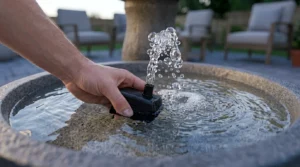
A pump that hums but won’t spray often has one of three problems. Air is stuck in the impeller. The intake is clogged. The water level is too low. Check the level first, then lift the pump and tilt it underwater until the bubbles stop. Rinse the intake screen last. Keep the pump fully covered with water the whole time it runs.
If the fountain is silent instead, look at the outlet. A tripped GFCI is a common culprit after a storm. Press reset and see if it holds. The commission says a GFCI that won’t come back on after reset should be replaced. If it trips again right away, stop and have an electrician check the fountain. Never bypass a GFCI. Safety comes first.
1 Proven Formula to Avoid a Painful Power Bill
Running cost comes down to one formula from the U.S. Department of Energy. Multiply the wattage by the hours the fountain runs each day. Divide by 1,000 and the answer is daily kilowatt-hours. Utilities bill by the kilowatt-hour, so that is the number to watch. Find the wattage on the pump’s label. The department notes the listed wattage is the maximum the appliance draws.
Try an example. A 25-watt pump running 10 hours a day uses 0.25 kWh. At an example rate of 15 cents per kWh, that is under 4 cents a day. A 5-watt light ring for 6 hours adds 0.03 kWh. Your own rate and wattage will differ, so plug in your numbers. Run the same math for any second pump. Keep the math simple.
Best Plug and Play Outdoor Fountain for Small Patios: 2026 Pick
Small patios do best with a small plug and play outdoor fountain. A 3-gallon basin weighs about 25 pounds when full. That is easy to place and easy to drain. Measure the spot first and mark the footprint with tape. Leave clear space on every side so wind spray doesn’t soak the furniture. Choose an adjustable flow dial so the spray stays low.
Check the cord length against the distance to your GFCI outlet before you buy. A cord that stretches tight pulls the plug loose and invites an extension cord. Count the steps from outlet to basin and leave a little slack. Slack protects the plug. Look for a pump you can lift out without moving the basin and lights you can switch off separately.
Plug and Play Fountain Setup Takeaways
Plug and play outdoor water fountains reward a short and careful setup. Level the base. Test the outlet. Prime the pump. Pick lights by lumens. Drain everything before the first hard freeze. No step is optional. Each one is quick and each one prevents a failure that is hard to spot later.
A fountain should add calm to a patio and not another chore. The setup is where that gets decided. Spend an afternoon on it. Write the GFCI test date on the calendar the day you plug in. Add the winter shutdown. Then enjoy the sound of water for the rest of the season.
If you would rather power a fountain with the sun, our guide on how to install solar water fountains with battery covers the sizing math. If this guide helped you set up your fountain, let us know in the comments below and share it with friends or family who are shopping for one.
Frequently Asked Questions (FAQs)
What is the best plug and play outdoor water fountain with lights?
The best plug and play outdoor water fountain with lights is a compact kit with an adjustable pump and a light ring rated for water. Pick one sized for your space since a full basin weighs about 8.3 pounds per gallon. Check that the cord reaches your GFCI outlet.
Do plug and play outdoor fountains need a GFCI outlet?
Yes. The U.S. Consumer Product Safety Commission says the National Electrical Code has required GFCI protection on outdoor outlets since 1973. If your outlet lacks one, a portable GFCI plugs in like any other cord.
How do you prime a fountain pump?
Submerge the pump fully in water and tilt it gently until the air bubbles escape. Then switch it on. Never let it run dry.
How much electricity does an outdoor fountain use?
Multiply the pump’s wattage by the hours it runs and divide by 1,000 to get daily kilowatt-hours, the method the U.S. Department of Energy uses. A 25-watt pump running 10 hours uses 0.25 kWh.
Do you need to bring a fountain pump inside for winter?
Yes, in freezing climates. Ice can crack the pump housing and the basin. Drain the basin and rinse the pump before you store it indoors.