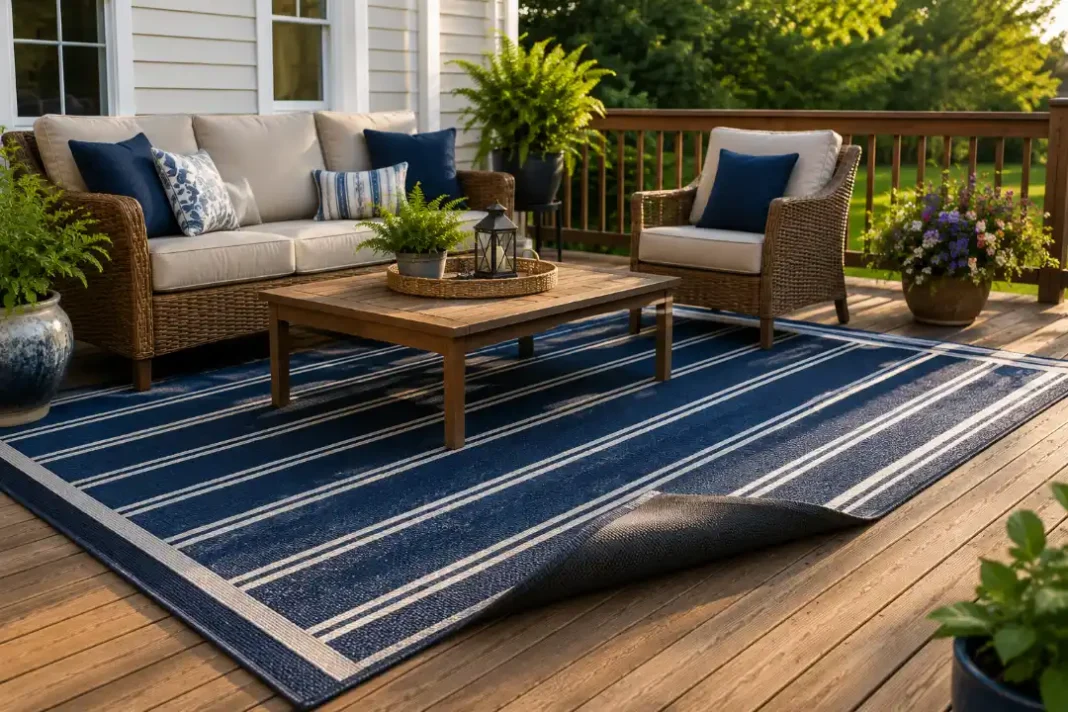

Rubber Backed Rug Deck: What’s Actually Happening Underneath

A rubber backed rug deck combination feels like the safest choice, since the grip keeps it from sliding around underfoot. That grip comes from a solid layer sealed tight against the floor, and on a wood deck, that same seal is exactly what causes the problem. A rubber backed rug deck combination can sit there looking perfectly fine for months while moisture quietly works against the boards the whole time.
Unlike breathable backings that let air pass through, rubber creates a barrier with nowhere for trapped water to go. This guide covers exactly how that happens, what it looks like once it does, and what actually keeps a rubber-backed rug safe to use.
How Rubber Backing Traps Moisture Against Wood
Solid rubber backing works by creating full contact with the floor beneath it, which is exactly what gives it that non-slip grip. On a rubber backed rug deck setup, that same full contact means any moisture, from rain, dew, or a spilled drink, gets sealed against the boards instead of evaporating into open air. The World Floor Covering Association specifically advises against putting anything with a solid rubber or latex backing over wood flooring, since trapped humidity can damage the finish and invite mildew growth underneath.
That guidance was written with indoor hardwood in mind, but it applies even more on a deck, where the wood is already exposed to outdoor humidity on top of whatever gets trapped by the rug itself. The backing doesn’t have to be defective to cause this; it’s doing exactly what it was designed to do: grip the floor. It just wasn’t designed with wood decking specifically in mind.
| Number & Insight | Source (Institute) | Expert / Team |
|---|---|---|
| The WFCA advises against solid rubber or latex backing directly on wood flooring, since trapped humidity can damage the finish and invite mildew underneath. | World Floor Covering Association, Consumer Guidance | WFCA Flooring Standards |
How to Inspect a Rubber Backed Rug for Deck Damage
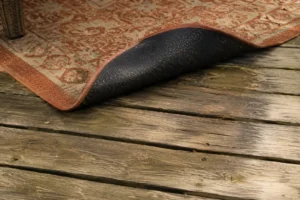
Checking for damage starts with your hand, not your eyes. Run it flat across the boards right after lifting the rug, comparing the covered section to the open deck around it. What you’re feeling for is cupping, a slight curl at the board edges that feels different from the flat surface elsewhere, and it’s the earliest thing to check since it happens before anything is visible just by looking. Once you’ve checked by feel, look at the wood finish itself for a faint waffle or basketweave texture, the rug backing’s grip pattern transferred onto the surface.
This is a specific, well-documented issue with rubber and latex backings, and it isn’t always something you can wipe away; sometimes the finish itself has reacted with the backing. Step back afterward and look at the overall color of the boards too, checking for a rectangle or oval of darker wood with a crisp edge that traces the rug’s exact shape. General weather staining is uneven, while this kind of discoloration matches the rug’s boundary almost perfectly, and it’s the clearest confirmation that moisture has been trapped consistently underneath.
How to Use a Rubber Backed Rug Safely on a Deck
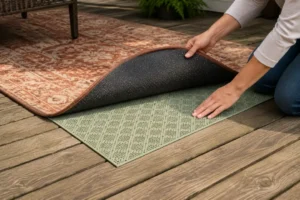
You don’t have to give up a rubber backed rug deck setup you already love; you just need to break the seal between it and the wood. Sliding a thin, breathable rug pad underneath restores airflow without sacrificing the grip the rubber backing provides on top. Look for a pad specifically labeled open-weave or ventilated, rather than another solid layer that just adds a second sealed barrier.
Lift the rug every couple of weeks, more often during humid stretches, and rotate its position slightly every few months if you can. Both habits target the same root cause, giving the wood underneath a real chance to dry out and avoid staying in one spot long enough to leave a permanent mark.
3 Steps to Remove a Waffle Imprint From a Wood Deck
This keyword is a Guide-format search, since the searcher wants a clear process to follow, not a cost comparison. Confirm it’s an imprint and not a sticky residue by running a dry cloth over the area. If the finish itself looks worn rather than coated, light sanding and a matching touch-up finish usually resolve it.
If there’s residue rather than just an imprint, a citrus-based adhesive remover applied gently, then wiped clean, typically lifts it without damaging the surrounding finish. Test any product in an inconspicuous spot first; deck finishes vary enough that what works on one won’t always work identically on another.
Best Breathable Rug Pad for a Rubber Backed Rug Under $50
This keyword is a Budget-format search, since the searcher is comparing products by price. A quality open-weave rug pad sized for a standard 8×10 area rug typically runs under $50, based on current retail pricing, and that single purchase solves the airflow problem without requiring you to replace the rug itself.
Spending more doesn’t necessarily buy better protection here; the ventilation design matters far more than the price point once you’re above that basic threshold. Measure your rug before buying rather than guessing; a pad that’s noticeably smaller or larger than the rug won’t seal the gap in coverage the way a properly sized one will.
2 Reasons to Replace a Rubber Backed Rug Entirely
This keyword is a Guide-format search, since it’s really asking for guidance on a decision, not a specific count. A backing that’s become brittle, cracking or flaking apart rather than staying flexible, sheds material directly onto your deck and is worth replacing on its own. A backing that’s already fused or bonded to the wood finish underneath is the other case, since removal will damage the finish either way, making replacement the more practical choice.
Either situation means the rug is actively working against your deck rather than just needing a pad underneath it. A brittle backing can’t be restored, and a fused one can’t be safely separated without risking the finish, so replacement genuinely is the more practical path in both cases rather than a fallback.
Our full breakdown of keeping an outdoor rug safe on a wooden deck covers the broader material comparison if you’re shopping for a full replacement rather than a rubber-backed rug specifically.
Conclusion
A rubber backed rug and a wood deck can work together safely as long as something breaks the seal between them. Add a breathable pad underneath, lift and rotate the rug on a regular schedule, and check for warping, imprint marks or outline-shaped discoloration every so often.
None of this means giving up the grip and safety rubber backing provides; it just means giving the wood underneath a real chance to breathe alongside it, the same way any other section of your deck does. A rubber backed rug deck combination handled this way protects both the rug and the boards for years, instead of trading one problem for another every time it rains.
Frequently Asked Questions (FAQs)
Do rubber backed rugs damage wood decks?
Yes, but only because the solid backing traps moisture against the boards, not because rubber itself is harmful to wood. A rubber backed rug deck setup with a breathable pad underneath solves most of the risk without requiring a different rug.
Can you put a rubber backed rug on a wood deck at all?
Yes, as long as you add a breathable pad underneath and lift it periodically to let the boards dry. The backing alone isn’t disqualifying; trapped moisture over time is what causes the damage.
Does a rubber backed rug leave permanent marks on a deck?
It can, especially if left in the same spot for a long stretch without being moved. Waffle-pattern imprints and outline-shaped discoloration are both possible, though usually fixable with light sanding or a touch-up finish.
How often should you move a rubber backed rug on a deck?
Rotating it slightly every few months, combined with lifting a corner every couple of weeks, prevents most of the marking and moisture issues covered above.
Is a breathable pad enough to make a rubber backed rug safe?
Yes, in most cases. A quality open-weave pad restores airflow between the rug and the boards, which addresses the root cause rather than just the symptoms. That’s why a rubber backed rug deck is safe for you.