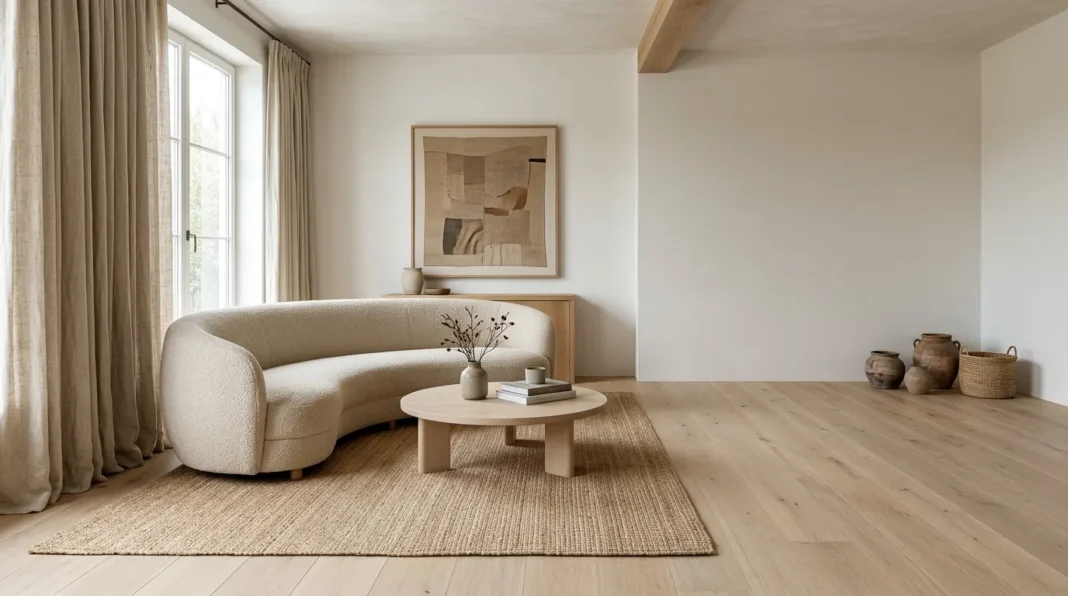
Design Organic Modern Room Layouts Around Natural Materials and Soft Edges
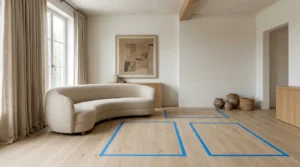
The simplest way to design organic modern room spaces is to start with open floor and natural surfaces before you buy a single new piece of furniture. Five easy steps follow, each tied to one named public source and one number you can check in your own room tonight with a tape measure.
Key Takeaways:
- Tape the floor first to keep clear space around every seat.
- Choose three shades from one earth-pigment family.
- Seal wood with low-fume finishes and open a window.
- Mix a smooth fiber with a rough one on every seat.
- Read labels before you trust a word like eco-friendly.
Each step ends with one task that fits in an afternoon. Four steps point to a deeper guide on the same topic. Named public sources supply every sourced fact. Our own arithmetic or labeled estimates cover the rest. No room trial sits behind this guide. Readers with a rental, a small budget or a first project can all start at step one.
A Five-Step Sequence for Planning, Finishing and Buying
These five steps follow the order of a real project. To design organic modern room layouts well, the floor plan comes first because everything else sits on it. Color comes second because paint is cheap to change before the furniture arrives. Finishes, fibers and shopping come next. Taping costs a roll of tape, so the cheapest check leads.
The middle step stands on its own and has no deeper guide. It covers wood finishes and the air around them. The other four steps each point to an article that goes further. Skip ahead to the step that matches your biggest problem. Each step also names one thing to do this week.
Tape Clear Floor Zones Before Any Furniture Arrives
To design organic modern room layouts that feel open, mark the floor before you shop. The U.S. Access Board’s guide to clear floor space and turning space sets a minimum of 30 by 48 inches for a clear floor space. It also sets a 60-inch circle as the smallest turning space. Those are accessibility standards for public buildings, not for private homes. Use them as a yardstick, not a home rule. The table below details clear floor space guidelines established by U.S. Access Board specialists.
| Number & Insight | Source | Expert/Team |
|---|---|---|
| The minimum clear floor space is 30 by 48 inches. | U.S. Access Board | U.S. Access Board |
| The 30 by 48 inch minimum applies to both forward and side approaches. | U.S. Access Board | U.S. Access Board |
| The minimum circular turning space is 60 inches in diameter. | U.S. Access Board | U.S. Access Board |
| A T-shaped turning space measures 60 inches across and 60 inches deep, with each arm and stem at least 36 inches wide. | U.S. Access Board | U.S. Access Board |
Try a three-rectangle test. Cut three strips of painter’s tape at 30 by 48 inches. Lay one beside the bed or sofa. Lay one in front of the main storage piece. Lay the last one at the door. Move any furniture that sits inside a rectangle. Three rectangles cover 30 square feet, so a 100-square-foot room keeps 70 for furniture (our arithmetic). Read how to lay out an organic modern room around real walking paths for a full plan.
Pick a Palette From One Earth-Pigment Family
To design organic modern room color palettes, borrow from earth pigments instead of paint chips alone. Britannica describes ochre as a native earth colored with hydrated iron oxide. It says the color ranges from pale yellow to deep red, brown and violet. One family can therefore give you every shade you need. Many paint lines sell sand and clay shades in the same range (our reading). The table below details earth pigment guidelines established by Britannica specialists.
| Number & Insight | Source | Expert/Team |
|---|---|---|
| Ochre is a native earth colored with hydrated iron oxide. | Britannica | Encyclopaedia Britannica |
| Ochre ranges from pale yellow to deep red, brown and violet. | Britannica | Encyclopaedia Britannica |
| One kind of ochre has a clayey base, and the other is a chalky earth. | Britannica | Encyclopaedia Britannica |
| The clayey kind is generally the richer and purer in color. | Britannica | Encyclopaedia Britannica |
Choose one family such as sand or clay. Pick its pale, middle and deep versions. The three shades will belong together by design. Hold each swatch beside a sheet of plain white paper to see its undertone (our tip). Reject any swatch with a gray or green cast beside your wood. Read which earth-tone colors keep an organic modern room warm for shade pairings.
Seal Wood With Low-Fume Finishes and Fresh Air
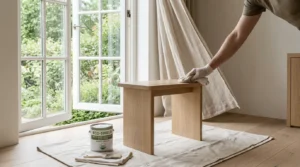
To design organic modern room surfaces safely, treat the finish as part of the material. Even a pale oak table usually carries a coat of something. The EPA’s page on VOCs in indoor air says paints, varnishes and wax all contain organic solvents. It adds that levels of many such compounds run up to ten times higher indoors than outdoors. The table below details indoor air guidelines established by EPA specialists.
| Number & Insight | Source | Expert/Team |
|---|---|---|
| Paints, varnishes and wax all contain organic solvents. | EPA | U.S. Environmental Protection Agency |
| Concentrations of many VOCs are consistently higher indoors, up to ten times higher, than outdoors. | EPA | U.S. Environmental Protection Agency |
| EPA’s TEAM Study found levels of about a dozen common organic pollutants 2 to 5 times higher inside homes than outside. | EPA | U.S. Environmental Protection Agency |
| Levels may reach 1,000 times background outdoor levels during and shortly after activities such as paint stripping. | EPA | U.S. Environmental Protection Agency |
| Increase ventilation when using products that emit VOCs. | EPA | U.S. Environmental Protection Agency |
Check the can for its VOC figure in grams per liter and pick the lower number (our reading of the label). Apply the finish with two windows open. Buy only as much as you will use that day, as the EPA advises for occasional products. Never store opened cans indoors. Test the finish on the underside of a table before you coat the top.
Pair a Smooth Fiber With a Rough One on Every Seat
To design organic modern room textures that last, start with linen. Britannica says linen is made from the flax plant. It also says linen is stronger than cotton and dries more quickly. Those two traits make it a sensible base layer for cushions, curtains and throws. Look for a label reading 100 percent linen if the budget allows (our tip). The table below details linen fiber guidelines established by Britannica specialists.
| Number & Insight | Source | Expert/Team |
|---|---|---|
| Linen is made from the flax plant. | Britannica | Encyclopaedia Britannica |
| Flax is one of the oldest textile fibres used by humans. | Britannica | Encyclopaedia Britannica |
| Linen is stronger than cotton. | Britannica | Encyclopaedia Britannica |
| Linen dries more quickly than cotton. | Britannica | Encyclopaedia Britannica |
Pair one smooth fiber with one rough fiber on every seat. A linen cover sits well on a wool throw. A jute runner adds grit under a smooth oak table. Keep the colors close so the texture does the talking. Wash linen once before first use to soften it (our tip). Read ways to layer natural textures without piling them up for pairings by room.
Read the Label Before You Trust the Word Natural
To design organic modern room shopping lists you can trust, treat green words as claims to check. The FTC’s 2012 revision of its Green Guides cautions against broad claims that a product is eco-friendly. It calls such claims nearly impossible to substantiate. A seller who relies on one word has proved nothing. Certificates and test reports count for more than icons (our reading). The table below details environmental marketing guidelines established by FTC specialists.
| Number & Insight | Source | Expert/Team |
|---|---|---|
| The FTC approved the revised Green Guides on October 1, 2012, by a 5-0 vote. | Federal Trade Commission | Federal Trade Commission |
| The Guides help marketers make truthful, non-deceptive environmental claims. | Federal Trade Commission | Federal Trade Commission |
| Broad claims such as eco-friendly suggest specific and far-reaching environmental benefits. | Federal Trade Commission | Federal Trade Commission |
| Such claims are nearly impossible to substantiate. | Federal Trade Commission | Federal Trade Commission |
Ask for the fiber content, the wood species and the finish before you pay. A specific answer beats a green word. A seller who answers only with the word natural has told you nothing (our reading). Buy one sample first, such as a single cushion cover. Read where to buy natural room decor with honest labels for shops and price ranges.
Organic Modern Versus Japandi: 2 Differences to Check
Organic modern leans on rounded shapes and warm, light wood. Japandi leans on low, straight lines and bare floors. Those are the two differences to check when both styles tempt you. They are our reading of the two styles and not a sourced rule. Look at the room you already own before you decide.
Pick organic modern if your sofa already has soft curves. Pick Japandi if you own a low sofa. Read the Japandi living room plan in five easy steps before you decide. A mixed room can borrow one idea from each style. Keep the taped floor zones from the first step either way. They work under both looks.
Organic Modern Starter Costs: 3 Purchases Under $60 Each
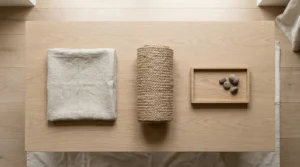
Three purchases under $60 each start the look. A linen cushion cover at about $25 comes first and tests the palette. A jute runner at about $50 comes second and tests the fiber pairing. A sealed wood tray at about $40 comes third and tests the finish. All three prices are our estimates, not checked quotes.
The three together cost about $115 by our arithmetic. Skip the runner if your floor already feels warm. Add a second cushion cover only after a week with the first. A small start shows which texture the room still lacks. That shows you the next purchase.
Organic Modern or Modern Farmhouse in a Bedroom: Our 2026 Pick
Organic modern is our 2026 pick for a bedroom with little wall space because the palette stays quiet. The wood stays pale too. Modern farmhouse relies on crisp white walls and dark hardware. That look needs more wall to work. Our pick reflects room size and not a rule from any source.
For white walls and black hardware, look at a modern farmhouse bedroom instead. Both styles share wood and linen. They differ in how loud the contrast is. Pick the quieter one if the bedroom is also where you work. Measure the wall behind the bed before you choose.
Tape the Floor Tonight and Let Every Later Choice Follow It
Tape the three floor zones tonight. That is the first move to design organic modern room spaces. The tape shows which piece to move before any paint is chosen. Pick one pigment family next. Choose one low-fume finish after that. Add one smooth fiber and one rough fiber last. Leave the tape down for a full week while you live in the room. Note each corner you still bump into.
Organic modern earns its calm by letting each material look like itself. Wood shows its grain and linen shows its weave. A good room needs no label to prove it. Trends change often. Open floor and honest finishes keep working through all of them. Which step changed your room most? Post your answer below and pass this guide along to a friend with a blank room.
Frequently Asked Questions (FAQs)
How do you design an organic modern room?
To design organic modern room spaces, tape clear floor zones first. Choose one earth-pigment family for color. Finish natural wood with a low-fume product. Pair a smooth fiber with a rough one on every seat. Check every green claim against the label.
What is organic modern style?
Organic modern mixes clean modern lines with natural materials such as wood, stone, linen and wool. It favors warm neutral colors and soft, rounded shapes. It avoids heavy patterns and matched furniture sets. The word describes a look, so no official rule defines it.
What colors work in an organic modern room?
Warm white, sand, clay and deep olive work well together in an organic modern room. Keep the walls pale and put the deep shade on one object. Stay inside one color family so nothing fights. Check each shade against your floor in daylight and in lamplight.
How much does it cost to design an organic modern room?
A small organic modern start costs about $115 in our estimate. A full room with a new sofa and table costs several times more. A secondhand wood table can cut that bill sharply. Treat them as our estimates and check prices in your area.
Can you design an organic modern room in a rental?
Yes, a rental can have an organic modern room. Use freestanding lamps, a jute runner and linen panels hung from a tension rod. Skip permanent paint and use removable wall hooks rated for the weight. Leave your existing furniture in place until the new layout proves itself.