How Do You Decorate Japandi Living Room Spaces Without Buying a Full Set
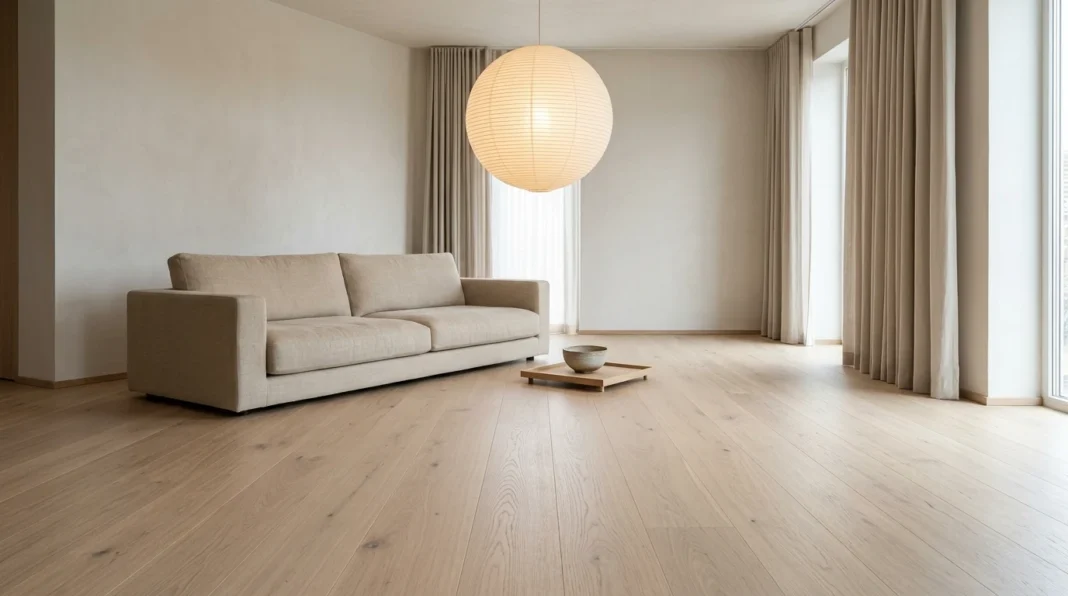
The simplest way to decorate Japandi living room spaces is to lower the furniture, keep only a few handmade objects and soften the room with wool and warm light. Most of that costs less than a new sofa, because the style rewards what you take away instead of what you buy.
Key Takeaways:
- Keep furniture low and leave visible floor between the pieces.
- Choose objects made for daily use over matched decor sets.
- Give every wall or shelf one rest point and nothing more.
- Add wool and linen so the calm never turns cold.
- Use warm, low lamps after dark.
Five easy steps follow, each of which fixes a single problem. Start at the floor, where the layout decides everything else. Finish at the lamp, since light shows whether the earlier steps worked. One free corner and one afternoon are enough to begin.
Five Easy Steps That Run From the Floor to the Lamp
Five easy steps fix the five most common reasons that a Japandi room feels cold or crowded. You can finish any one of them in a single afternoon. Step 3 carries the idea behind the whole look and costs nothing to do. It also shows how a bare wall can look finished instead of forgotten.
Lower the Furniture Line and Free the Floor
When you decorate Japandi living room seating, the first move is height, because low pieces keep the floor visible. Britannica’s survey of Japanese interiors describes sparse furniture in a traditional house and rooms measured in multiples of a floor mat of 6 by 3 feet. The table below details Japanese interior layout guidelines established by Britannica specialists.
| Number & Insight | Source | Expert/Team |
|---|---|---|
| Rooms are reckoned in multiples of one floor-mat unit measuring 6 by 3 feet (1.8 by 0.9 meters). | Britannica | Encyclopaedia Britannica |
| The furniture in a traditional Japanese house is sparse, perhaps a cabinet of blackwood or lacquer, a low writing table or a screen. | Britannica | Encyclopaedia Britannica |
| Sliding doors stand 5 feet 8 inches (1.7 meters) high and 3 feet (0.9 meters) wide. | Britannica | Encyclopaedia Britannica |
| Supporting pillars measure 4 to 5 inches (10 to 13 cm) square and sit at 6-foot (1.8 meter) intervals. | Britannica | Encyclopaedia Britannica |
Try a floor-mat test. Tape a 6-by-3-foot rectangle on the floor and count how many stay bare with the furniture in place. A renter can free two by swapping the coffee table for floor cushions. Sizes and swaps are covered in how to fit Japandi furniture into a real room.
Fill Shelves With Things a Person Made
To decorate Japandi living room shelves well, choose handmade ceramics that were made for daily use over any matched decor set. Britannica’s profile of the potter Kawai Kanjirō says he started the folk-art movement in 1925 with Yanagi Sōetsu and Hamada Shōji. The table below details folk-craft pottery guidelines established by Britannica specialists.
| Number & Insight | Source | Expert/Team |
|---|---|---|
| Kawai Kanjirō lived from August 24, 1890 to November 18, 1966. | Britannica | Encyclopaedia Britannica |
| In 1920, he built his own kiln in Kyōto and began to give exhibitions. | Britannica | Encyclopaedia Britannica |
| In 1925, he started the folk-art movement with Yanagi Sōetsu and Hamada Shōji, developing ceramic ware for daily use. | Britannica | Encyclopaedia Britannica |
| His ware employed styles from the old folk arts of Japan and England. | Britannica | Encyclopaedia Britannica |
Whatever you buy should be used and not just displayed, because a bowl that holds fruit earns its place faster. Plan on about $20 for a handmade bowl or $50 for a bowl plus a basket (both our estimates). A short list of shops and price ranges for handmade Japandi pieces helps you compare first.
Take One Lesson From the Tea Room and Leave Space Bare

The Japanese tea room is the best model for restraint in a living room. The Metropolitan Museum of Art’s essay on the tea ceremony says the wabi aesthetic celebrates austerity, spontaneity and apparent artlessness. It adds that the room is usually large enough for only four or five people. The table below details wabi tea-room guidelines established by Metropolitan Museum of Art specialists.
| Number & Insight | Source | Expert/Team |
|---|---|---|
| The tea ceremony as it is known today emerged in the sixteenth century. | Metropolitan Museum of Art | Anna Willmann, Metropolitan Museum of Art |
| Tea masters such as Sen no Rikyū (1522 to 1591) pioneered a shift in the mid-sixteenth century. | Metropolitan Museum of Art | Anna Willmann, Metropolitan Museum of Art |
| The wabi aesthetic celebrates austerity, spontaneity and apparent artlessness. | Metropolitan Museum of Art | Anna Willmann, Metropolitan Museum of Art |
| The tea room is usually only large enough for four or five people and is modeled on a hermit’s hut. | Metropolitan Museum of Art | Anna Willmann, Metropolitan Museum of Art |
| Many ceramics used in the ceremony are unglazed stoneware, first intended as utilitarian vessels for farmers. | Metropolitan Museum of Art | Anna Willmann, Metropolitan Museum of Art |
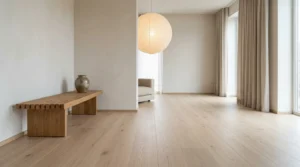
To decorate Japandi living room walls without paint or drilling, pick one shelf or table as the rest point and keep a single object on it for three days. If a bare wall still feels severe, add one linen panel or a small plant beside the shelf instead of a second object.
Soften the Edges With Scandinavian Wool and Oak
Scandinavian pieces keep Japanese restraint from feeling stark in a room that has little else to soften it. The Metropolitan Museum of Art’s essay on design from 1950 to 1975 says Scandinavian designers preferred to combine the traditional beauty of natural materials with advanced technology, giving their designs a warm and domestic yet modern quality. The table below details Scandinavian modern design guidelines established by Metropolitan Museum of Art specialists.
| Number & Insight | Source | Expert/Team |
|---|---|---|
| Scandinavian designers preferred to combine the traditional beauty of natural materials with advanced technology. | Metropolitan Museum of Art | Jared Goss, Metropolitan Museum of Art |
| Their designs had a warm and domestic yet modern quality. | Metropolitan Museum of Art | Jared Goss, Metropolitan Museum of Art |
| Examples include Timo Sarpaneva’s Lansetti II glass vase (1952) and Arne Jacobsen’s Egg armchair (1958). | Metropolitan Museum of Art | Jared Goss, Metropolitan Museum of Art |
| Verner Panton’s stacking side chair was designed in 1960 and manufactured around 1973. | Metropolitan Museum of Art | Jared Goss, Metropolitan Museum of Art |
To decorate Japandi living room corners that feel hard, start with one wool throw and one thick linen cushion cover. Limit the visible wood to two tones, such as pale oak and a darker shelf. The details of blending Scandinavian pieces into a Japanese-leaning room show three ways to do it.
Set the Evening Lighting for Sleep as Well as Sitting
When you decorate Japandi living room lighting, aim for a room that dims and quiets after sunset. The NHLBI page on healthy sleep habits advises a quiet, cool and dark bedroom and warns that bright screen light may signal the brain to stay awake. The table below details sleep environment guidelines established by NHLBI specialists.
| Number & Insight | Source | Expert/Team |
|---|---|---|
| Keep your bedroom quiet, cool and dark. A dim night light is fine if needed. | NHLBI | NHLBI, National Institutes of Health |
| Avoid bright artificial light such as from a TV or computer screen, which may signal the brain that it is time to be awake. | NHLBI | NHLBI, National Institutes of Health |
| Try to keep the same sleep schedule on weeknights and weekends and limit the difference to no more than about an hour. | NHLBI | NHLBI, National Institutes of Health |
| Adults should nap for no more than 20 minutes. | NHLBI | NHLBI, National Institutes of Health |
This matters most in a studio where the sofa doubles as a bed. Use warm bulbs labeled 2700K under paper shades and keep the lamps below eye level. For the sleeping side of the same room, read about how a small Japandi bedroom handles light and noise.
Japandi Living Room Rules for Renters: 5 No-Drill Swaps
A renter can decorate Japandi living room spaces with five swaps that never touch the walls. Replace the existing lampshades with paper or linen ones that diffuse the light. Trade a glossy rug for flat-weave wool or jute. Hang sheer linen panels where heavy curtains used to hang.
Swap the coffee table for floor cushions and a small tray table. Then clear each shelf to two or three objects with space around them. Keep every original piece until the new layout feels finished. Returns and resales take time.
Japandi Living Room Budget: Where the First $150 Goes
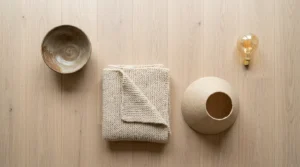
The first $150 goes furthest on three things when you decorate Japandi living room spaces from scratch. Spend about $60 on one handmade ceramic piece and about $40 on paper shades with warm bulbs. Put the last $50 into a wool throw that you will actually touch. All three figures are our estimates and not checked prices.
Skip matching sets and large wall art for now. Step 3 costs nothing at all. Space in the room is free. If $150 is too much, a $20 handmade bowl or a plain paper shade still changes the mood on the first day.
Japandi or Scandinavian for a Small Living Room: 2026 Pick
Japandi is our 2026 pick for a small living room because its furniture stays low and sparse. Britannica calls traditional Japanese furniture sparse, which leaves more bare floor in a tight space than a fully layered room would.
Scandinavian design still earns its place in a small room through warmth. Japandi borrows that warmth through wool and oak but keeps the emptiness. If both still feel too cool, a modern farmhouse bedroom that leans on wood, linen and warm light shows a warmer third route.
What to Do This Weekend and What to Leave Alone
Lower one piece of furniture, buy one handmade object and clear one wall. That short sequence does more than any shopping list when you decorate Japandi living room spaces. Then walk in from the doorway and look again with fresh eyes, because the room usually tells you what to leave alone.
Japandi joins sixteenth-century tea-room restraint with mid-century Scandinavian warmth. That pairing explains why the style still feels current. Most calm interiors work for the same reason, since they ask what a room can lose before they ask what it needs. Tell us in the comments which step helped most. Send this to a friend with a bare wall.
Frequently Asked Questions (FAQs)
How do you decorate a Japandi living room?
To decorate a Japandi living room, lower the furniture, keep a few handmade objects and leave floor and wall space empty. Add wool and linen for warmth and use dim lamps after dark, because most rooms need subtraction before purchases.
What furniture belongs in a Japandi living room?
A Japandi living room needs a low sofa, a small tray table or coffee table and one storage piece such as a cabinet or low shelf. Britannica describes the furniture in a traditional Japanese house as sparse. Anything beyond the basics should earn its floor space.
How much does it cost to decorate a Japandi living room?
A first pass costs about $150 in our estimate and covers one handmade ceramic piece, paper shades with warm bulbs and a wool throw. A single handmade bowl at about $20 is a cheaper place to start. These are editorial estimates, so compare them with local prices.
What colors work in a Japandi living room?
Warm white, oatmeal, pale oak and one dark accent, such as charcoal, work in a Japandi living room. Keep the palette to two or three earth tones. Test each shade next to your real wood before you commit.
Does Japandi work in a small apartment living room?
Japandi suits a small apartment living room because low furniture and a bare floor make the space read as larger. A renter can swap shades, rugs and curtains without touching the walls. Keep one tall piece against a wall for height.