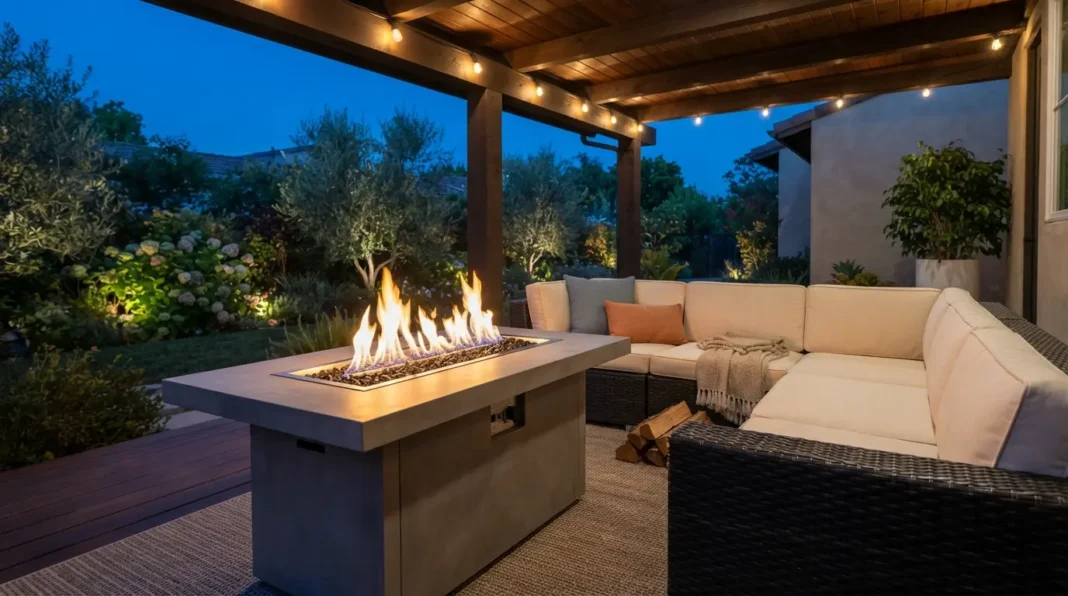
The Best Propane Fire Pit Tables for 2026
Propane fire pit tables solve the covered-porch problem a wood-burning pit or full-size fire feature cannot: real visible flame with near-zero ember output, provided the specific model actually carries manufacturer approval for covered or partially enclosed use. Look for that approval explicitly stated in the product listing rather than assumed, since not every propane table is rated for anything beyond open-air use. Most covered-porch owners either skip a fire feature entirely or use one never rated for the space, and neither is necessary once approval and ventilation get treated as the real decision.
Key Takeaways
- Confirm manufacturer approval for covered or partially enclosed use before assuming any propane table qualifies
- Tank clearance from the active flame matters regardless of whether the tank is exposed or concealed
- Compact tables run 30,000-40,000 BTUs; larger and high-output models can exceed 60,000 BTUs
- Concealed-tank cabinets need their own dedicated ventilation, not just the burner’s covered-use rating.
- A table rated for open-air use only should never run under a roof due to carbon monoxide buildup risk
This guide ranks five propane tables built for exactly that setting, from a compact square design to a high-BTU table for colder climates. Every pick below gets checked against real open-flame and gas-appliance safety guidance, since a table with the wrong tank placement or no covered-use rating defeats the entire purpose of adding one. Scroll past the takeaways below and jump to whichever table matches your porch.
Five Propane Fire Pit Tables Worth Considering
Every one of these propane fire pit tables solves a slightly different version of the same problem: real flame and warmth on a covered porch without the ember risk a wood-burning pit would bring. The middle pick covers the covered-space safety standards worth checking regardless of style, and the other four cover size, tank placement, and heat output.
The Compact Square Propane Fire Pit Table
A compact square table with a small burner ring is one of the smallest propane fire pit tables suited to a narrow porch or a corner spot where a larger table would crowd the seating. Most compact designs run 30,000 to 40,000 BTUs, enough ambient warmth for two or three people sitting close without overwhelming a partially enclosed space.
The smaller footprint also means a smaller tank compartment, so refills happen more often than on a larger table. This pick suits a porch under 100 square feet where the table needs to share space with a small seating arrangement rather than anchor a full layout.
The Rectangular Propane Table for Longer Seating Runs
A rectangular table with a longer burner run spreads flame and warmth across a wider seating arrangement, working well alongside a rectangular sectional or a run of chairs along one wall. BTU output typically scales up with table length, often reaching 50,000 or more on larger models, which throws noticeably more heat than a compact square design.
That higher output means checking manufacturer clearance guidance becomes even more important, since more heat radiates further from the table’s edge. This pick fits naturally on a covered porch with a longer, narrower footprint rather than a square or compact layout.
The Table Built to Real Covered-Space Safety Standards
Every one of these propane fire pit tables intended for a covered porch comes down to one question most buyers skip: does the manufacturer actually rate this specific model for covered or partially enclosed use, or is that assumption being made without checking? A table built and tested for open-air use only can behave differently under a roof, where heat and combustion byproducts have less room to dissipate than in fully open air.
Confirming that rating on the product listing, rather than assuming “outdoor” automatically covers covered spaces too, is the single most important check before buying. Tank placement matters just as much once the rating is confirmed: a spare or connected propane cylinder needs clearance from the active flame and should never sit tucked directly beneath the burner where heat can build up around it. The table below details open-flame and gas-appliance safety guidelines established by NFPA specialists.
| Number & Insight | Source | Expert/Team |
|---|---|---|
| NFPA guidance on propane and gas-fueled outdoor appliances stresses confirming manufacturer approval before using any fire feature under a covered structure, along with proper tank clearance from the flame | NFPA | National Fire Protection Association |
The Tank-Concealed Propane Table for Clean Looks
A table with the propane tank fully concealed inside a cabinet base hides the tank from view entirely, which suits buyers who want the look of a clean fire feature without a visible cylinder beside it. That cabinet needs its own ventilation built in, since a fully sealed compartment holding a propane tank creates its own separate safety concern regardless of the burner’s covered-use rating.
Buyers should confirm the cabinet has vents specifically designed for tank storage rather than assuming any enclosed base is safe by default. This pick suits buyers prioritizing appearance who are willing to pay a premium for the concealment feature over a simpler side-mounted tank design.
The High-BTU Propane Table for Colder Climates
A high-BTU table, often 60,000 BTUs or more, throws enough heat to make a real difference in colder climates where a lower-output table would barely take the chill off. That higher output uses fuel faster, so a larger propane tank or more frequent refills become part of the real running cost, not just the upfront table price. This size also demands the most attention to manufacturer clearance guidance, since maximum output on any fire feature means maximum radiant heat reaching nearby surfaces.
Buyers in consistently cold regions benefit most from this size, while anyone in a milder climate likely gets more practical value from a lower-BTU table that uses less fuel per session.
How Many BTUs Does a Covered Porch Table Need? (2026 Pick)
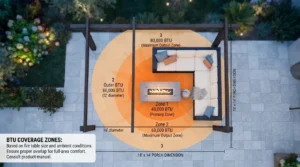
A compact table running 30,000 to 40,000 BTUs handles a small covered porch and two or three people comfortably, while a larger gathering or a colder climate benefits from 50,000 BTUs or more. Covered spaces often feel warmer at a given BTU output than fully open air, since the roof traps some radiant heat rather than letting it dissipate upward freely.
Buyers uncertain between two BTU ranges should generally size down rather than up for a covered space, since the enclosure itself provides some natural warmth retention that open-air use does not get.
Propane vs Natural Gas Fire Tables: Which Adds $200 in Install Cost?
Natural gas tables typically cost $150 to $250 more to install than a comparable propane model, since gas tables require a professional line run from the home’s existing gas supply rather than simply connecting a portable tank. Propane closes that gap entirely on upfront cost, trading the installation savings for the ongoing task of monitoring and refilling a tank.
Buyers planning to keep a table in one permanent spot for years often find natural gas worth the higher install cost over time, while anyone wanting portability should stick with propane regardless of the price difference.
Is It Safe to Run a Propane Table Under a Roof? (CO Check)
A propane fire table rated specifically for covered use handles the reduced airflow under a roof safely, since manufacturer testing accounts for that reduced ventilation in the approval itself. A table rated for open-air use only should never run under a roof, since it was never tested for the carbon monoxide buildup that reduced airflow can create.
Checking the specific covered-use rating before buying, rather than assuming any propane table is automatically fine indoors or under a roof, is the single check that prevents this exact risk.
Conclusion
A propane table earns its spot on a covered porch the moment it adds real flame and warmth without the ember risk a wood-burning pit would bring to an enclosed space. The lesson from every pick above is the same: check manufacturer approval and tank placement before checking the finish, since a table never rated for covered use defeats the entire purpose of buying one for that exact spot. Pair the right table with the right BTU output and the cold-porch problem that ends most fall evenings early simply goes away.
This is really a ventilation-and-approval question wearing a lifestyle upgrade, showing up the same on screened porches, pergolas, and partially open patios. Get the approval and tank clearance right, and BTU output and finish become simple taste calls. Save this whole guide, measure your porch carefully before ordering anything, and check out our companion pillar on fire pits for wooden decks if an open deck setup is still worth considering.
Frequently Asked Questions (FAQs)
Are propane fire pit tables safe for covered porches?
Yes, propane fire pit tables can be safe for covered porches, but only when the specific model carries manufacturer approval for covered or partially enclosed use, since a table rated for open-air use only was never tested for the reduced airflow a roof creates.
How do I know if my fire table is rated for covered use?
Check the product listing or owner’s manual for explicit language about covered, partially enclosed, or under-roof use, and contact the manufacturer directly if that information is not clearly stated rather than assuming it applies.
Where should the propane tank sit relative to the table?
The tank should sit with clear space around it and away from the direct flame, never tucked immediately beneath the burner where heat can build up, regardless of whether the tank is exposed or concealed in a cabinet base.
Do propane fire tables produce carbon monoxide?
Yes, any propane combustion produces carbon monoxide as a byproduct, which is why covered-use approval and adequate airflow matter more under a roof than in fully open air where byproducts dissipate more easily.
Can I convert a propane fire table to natural gas?
Some models offer a conversion kit for natural gas, but this typically requires professional installation and is not universal across all propane tables, so checking compatibility with the specific model before assuming a conversion is possible matters.