How To Spot Fake Product Reviews Before You Buy

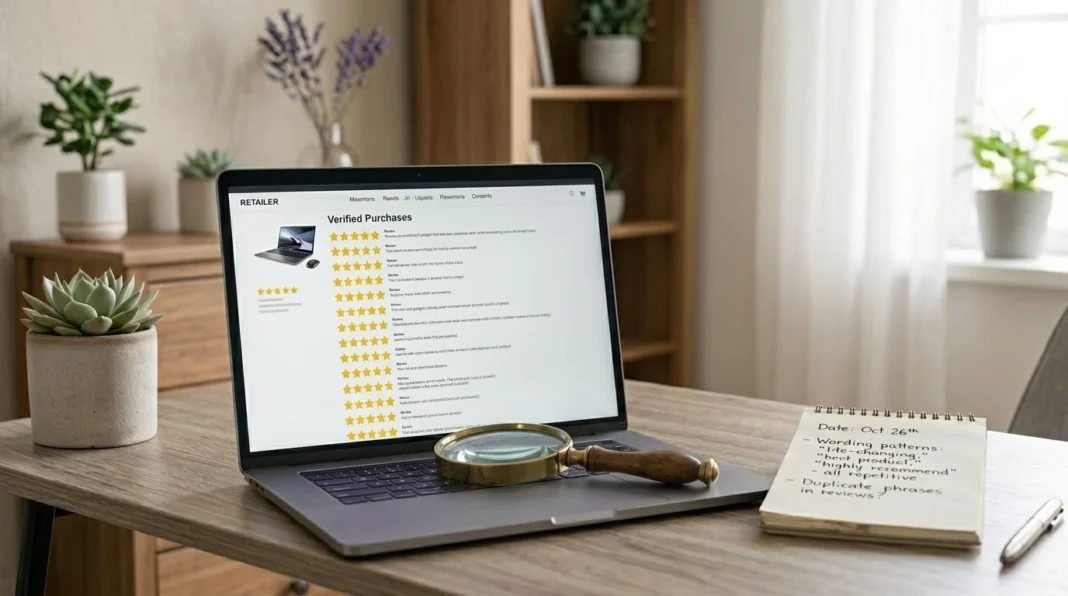
The fastest way to spot fake product reviews is to read the pattern and not the stars. Check when the reviews were posted. Check who wrote them. Check whether the wording repeats. Fake reviews can be positive or negative. A product with a perfect score can still be a trap. A product with a rough score can be the target of fake attacks. This guide shows the three mistakes that trip up careful shoppers and how to fix each one.
Key Takeaways:
- Star ratings alone prove nothing because fake reviews can be positive or negative.
- Check where a review is posted, who wrote it and the reviewer’s history.
- The FTC fake reviews rule went into effect October 21, 2024, but hosting sites are not required to screen reviews.
- Ranking sites may be run by manufacturers or list products only when sellers pay.
- Search the product or company name plus “complaint” or “scam” before you pay.
Decor and furniture shoppers face a special risk. Big items cost a lot. A wrong choice costs money and weeks of waiting. Reviews feel like a safe shortcut. They are only safe when you read them with care. Work through the three mistakes below in order. Take a screenshot of anything that looks odd. Keep your notes in one folder. Bookmark this guide before your next big purchase so the checks are ready when you need them.
Three Mistakes That Make Fake Reviews Work
Three common mistakes lead shoppers astray again and again. Each one has a simple fix. Read the mistake and then apply the fix on your next purchase. You do not need special software for any of it. A calm look at dates, wording and money does most of the work.
Trusting Star Ratings Alone
A high star average feels like proof. It is not. The FTC says not to rely on star ratings alone because some reviews and ratings are fake or misleading. Fake reviews can be positive or negative. So a perfect score can be inflated and a low score can be attacked. To spot fake product reviews, check several sources. Look at where each review is posted. Look at who wrote it. Look at the reviewer’s history. A profile that praises one brand and nothing else deserves suspicion.
Now read the reviews themselves. Sort by newest. Look for a burst of five-star posts on the same day with near-identical wording. Read the three-star reviews because they often hold the most balanced detail. Paste an odd phrase in quotes into a search engine. If the same text appears on other listings, treat the review as copied. Real buyers tend to mention specifics like fit, assembly time or fabric feel.
Assuming Someone Is Screening Reviews For You
Many shoppers think the site checks every review. That is a risky assumption. The FTC says a business that only hosts reviews is generally exempt from liability for them. It also says the rule places no obligation on such sites to screen reviews for authenticity. So the site itself is not your safety net. You are. Ask who benefits from each glowing review. The rule also requires company insiders to disclose their relationship, so a missing disclosure is a red flag.
Know what the rule bans. The FTC fake reviews rule went into effect on October 21, 2024. It bars fake reviews from people who do not exist, including AI-generated ones. It also bars paying for reviews tied to a particular sentiment. The FTC announcement of the fake reviews rule lists the full set. Save a screenshot of the review page if something looks off. The table below details fake-review guidelines established by FTC specialists.
| Number & Insight | Source | Expert/Team |
|---|---|---|
| October 21, 2024 is the date the FTC consumer reviews and testimonials rule went into effect (verified October 2026) | FTC, The Consumer Reviews and Testimonials Rule: Questions and Answers | FTC business guidance |
| The rule bars creating, selling, buying or spreading fake reviews from people who do not exist or lack real experience, including AI-generated ones as well as compensation conditioned on a particular sentiment. | FTC, Final Rule Banning Fake Reviews and Testimonials | FTC Commission (approved 5-0) |
| A business that only hosts reviews is generally exempt from liability and the rule imposes no obligation to screen reviews for authenticity. | FTC, The Consumer Reviews and Testimonials Rule: Questions and Answers | FTC business guidance |
| Insiders must clearly and conspicuously disclose their relationship to the business. | FTC, The Consumer Reviews and Testimonials Rule: Questions and Answers | FTC business guidance |
Trusting Ranking Sites Without Checking Who Pays
A best-of list looks neutral. Often it is not. The FTC warns that some comparison sites are run by manufacturers to promote their own products. It also warns that some companies run sites that only list or rank products if sellers pay them. So a top spot may be an ad. Look for a page that explains how it picks winners. Look for clear disclosure of money. If you find neither, treat the ranking as a lead and not as proof.
Then confirm with outside evidence. Search the product or company name plus the words complaint or scam. The FTC suggests exactly this check. Compare what independent buyers say about delivery, fit and returns. Watch for social media ads too. They are not always vetted, so an ad that looks legitimate may not be. Screenshot the ranking page and the complaint results so you can compare them later. Do this before you add the item to your cart.
How Many Five-Star Reviews Look Suspicious? (3-Part Check)
There is no magic number you can rely on. So to spot fake product reviews, look at patterns instead. Check three things. First, the dates. Many five-star posts on the same day are a flag. Second, the wording. Repeated phrases and vague praise are flags. Third, the reviewer. A profile with one review or one brand is a flag. Any single flag is only a hint. Two or three together deserve a pause before you pay.
Then test the opposite side. Read the lowest reviews. Ask whether the complaints are specific and believable. Remember the FTC warning that fake reviews can be positive or negative. A wave of one-star posts with the same wording can be an attack on the product. Compare the story across several sources before you decide. Take notes as you go so the pattern is easy to see. Walk away if the pattern stays murky.
Are AI-Generated Reviews Banned? (2026 Rule Check)
The FTC says its rule covers fake reviews from people who do not exist, including AI-generated ones. Businesses cannot create, sell, buy or spread them when they knew or should have known they were fake. The rule went into effect on October 21, 2024. Ordinary consumers cannot be liable for what they write. That protects honest shoppers who leave real reviews. It targets the businesses that arrange fake ones.
A rule does not make fakes disappear. The FTC can seek civil penalties against knowing violators. Meanwhile, the work of spotting them still falls on you. AI text can sound smooth and generic. Look for reviews with no specific details. Check whether the details match the product photos and the product page. Trust the details you can verify and ignore the rest. A real buyer can usually say something only an owner would know.
Should You Trust A $20 Item With Only Five-Star Reviews? (Example)
Be careful. A perfect score on a cheap item can be real. It can also be bought. The FTC cautions against relying on star ratings alone. Run the same three checks on dates, wording and reviewers. Then search the product and seller name with the words complaint or scam. If independent buyers describe the same problem again and again, believe them over the listing. The price is an example and the method works at any price.
Compare the item across stores. If one seller shows a sky-high score and others show mixed results for the same product, ask why. Check that review photos and details match the exact item you plan to buy. Save screenshots of the listing and the reviews you relied on. If the item arrives and does not match, you will have proof of what the page promised. Check the return policy before you buy in case the item disappoints.
Conclusion
To spot fake product reviews, read the pattern and not the stars. Check dates, wording and reviewer history. Do not assume the site screens reviews for you. Do not trust a ranking page until you know who pays. Confirm with a search for complaints. These steps take minutes. They can save you weeks of waiting on a product that never matched its reviews. Treat every review as a clue and not as a promise. That habit costs nothing and works on every site.
Reviews are one layer of safe shopping. Fake stores and fake reviews often travel together. Read how to avoid online shopping scams before your next big order. It covers the seller checks that sit beside the review checks. Share this guide with a friend who buys on five-star ratings alone. Then tell us the most suspicious review you have seen. Your example may help another shopper. Small habits like these protect your whole budget.
Frequently Asked Questions (FAQs)
How do you spot fake product reviews?
Spot fake product reviews by checking when they were posted and who wrote them. Look for repeated wording and clusters of five-star posts on the same day. Do not rely on star ratings alone. Search the product or company name with the words complaint or scam.
Are fake reviews illegal?
The FTC rule banning fake reviews and testimonials went into effect October 21, 2024. It bars creating, selling, buying or spreading fake reviews, including AI-generated ones. The FTC can seek civil penalties against knowing violators. Ordinary consumers cannot be liable for what they write.
Do review sites check that reviews are real?
Not necessarily. The FTC says a business that only hosts reviews is generally exempt from liability for them. The rule does not require such sites to screen reviews for authenticity. Treat the site as a library of opinions and not as a fact-checker.
Can a company pay for five-star reviews?
Not if the reward depends on the sentiment. The FTC says incentives are allowed unless there is an express or implied requirement that the reviews express a particular sentiment. Offering incentives for five-star reviews is prohibited.
Where can you report fake reviews or scam sellers?
Report suspected scams to the FTC at ReportFraud.ftc.gov. Include screenshots of the review page and the seller details. Keep your order records and card statement in case you need to dispute a charge.