Layer Organic Room Textures From the Floor Up Before You Add Soft Goods
The simplest way to layer organic room textures is to build from the floor up with fibers you can name, then stop at four textures in the room. Five easy hacks follow for rugs, curtains, linen, hard surfaces and repeats, with each one tied to a price estimate plus a rule you can check by eye.
Key Takeaways
- Floor first, then seating, then windows, then small objects.
- Linen wrinkles, so plan loose fits where creases look natural.
- Four textures per room is our 2026 pick.
- A $105 starter set covers four layers.
A bare room needs the floor layer first. A furnished room may need only one new piece. Both follow the same order from floor to shelf. A studio can skip the curtain stage until the rest feels settled. Prices here are our own rough guesses. Wikipedia supplies the only sourced linen facts.
Five Hacks That Move From the Floor to the Shelf
Texture layers work best when they go on in order. The floor goes first, then the seating, then the windows and last the small objects. Each stage has one rule and one price estimate. The wider room plan sits in the organic modern room plan for floors, finishes and fibers.
Rough goes low and smooth goes high in rooms where you layer organic room textures (our reading). Skip a stage if your room already handles it. A room with a patterned rug needs no floor work. A room with bare windows should start with hack two. Photograph the room after each stage.
Lay a Coarse Rug First and Place a Softer Piece on Top
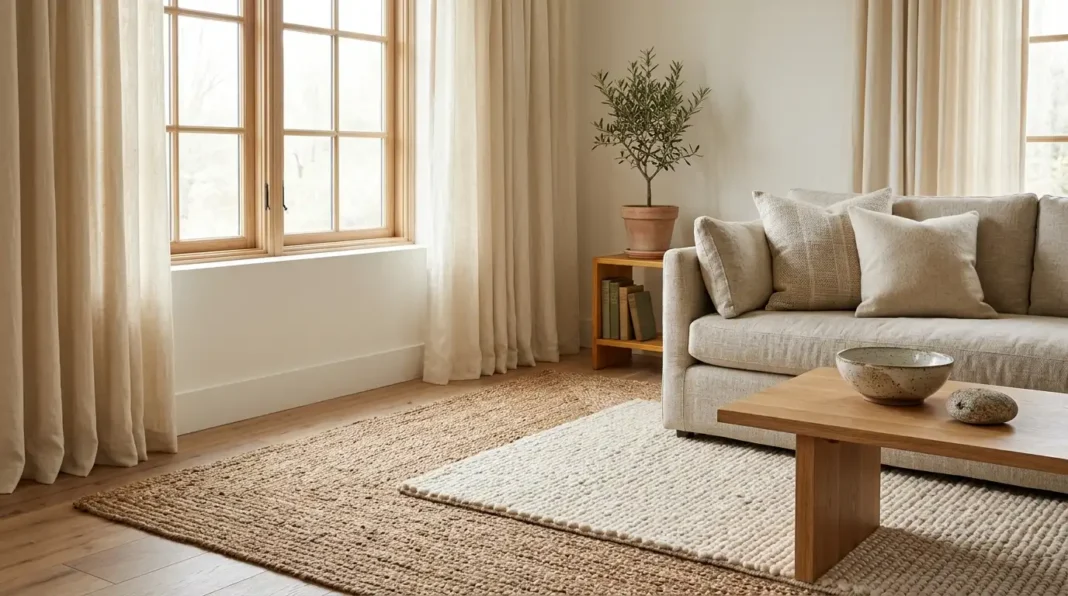
A coarse base rug anchors the floor and defines the seating zone. A 5-by-8-foot jute rug costs about $90 by our estimate. A 3-by-5-foot version costs about $35 (our estimate). Jute is a stiff plant fiber with a dry feel. Rest the front legs of the sofa on it. Mark the seating zone first with painter’s tape.
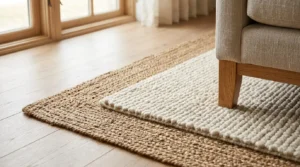
Add a softer piece on top at a slight angle. A 2-by-3-foot wool mat costs about $30 (our estimate). Leave a 6-inch border of jute showing on the short sides so the two textures read as separate layers. A rug pad under the base stops the stack from creeping across the floor.
Hang Light Linen High and Keep Heavy Weaves Low
Heavy weaves belong low and light weaves belong high. Wool, jute and rough wood sit near the floor. Linen curtains and thin cotton sit near the ceiling. The eye then travels up through lighter layers. Hang the curtain rod close to the ceiling to stretch the wall (our reading). A pale panel lifts a low ceiling visually (our reading).
A linen curtain panel costs about $45 by our estimate. Choose a panel one and a half times the window width for soft folds. Let the hem brush the floor or stop a half inch above it. Light panels filter daylight without blocking it (our reading). Hold a sample against the window before you order.
Let Linen Wrinkle Where a Crease Looks Natural
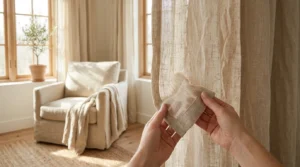
Linen wrinkles easily and the creases suit an organic modern room. The Wikipedia entry on linen says so plainly. Plan for the crease on curtains, throws and loose cushion covers. Avoid tight linen on a fitted sofa where wrinkles read as sloppy (our reading). A relaxed fit makes the crease look intended. The table below details linen fiber behavior guidelines established by Wikipedia specialists.
| Number & Insight | Source | Expert/Team |
|---|---|---|
| Linen wrinkles very easily. | Wikipedia | Wikipedia contributors |
| Linen feels cool to the touch and the page ties this to its thermal conductivity. | Wikipedia | Wikipedia contributors |
| Linen is described as very absorbent. | Wikipedia | Wikipedia contributors |
| Retting uses bacteria to break down the pectin that binds the fibers together. | Wikipedia | Wikipedia contributors |
| Linen fibers run about 25 to 150 mm long with an average diameter of 12 to 16 micrometers. | Wikipedia | Wikipedia contributors |
Place linen where its habits help. High absorbency suits a curtain near a damp kitchen window (our reading). A cool feel suits a sunny reading chair. Fibers only 12 to 16 micrometers across give the cloth a soft drape (our reading). Skip ironing to keep the texture. Steam a panel lightly if one crease looks too deep.
Break the Soft Layers With One Hard Smooth Surface
A hard smooth surface gives the eye a rest between soft layers. Stone, glazed ceramic and sealed wood all do the job. A sealed wood bowl or a ceramic dish costs about $15, by our estimate. Set it on the coffee table or a shelf where soft textiles surround it. Matte stone shows texture better than polished stone (our reading).
Place the hard piece next to the softest one. A ceramic dish beside a boucle cushion shows both textures at once. Leave the dish mostly empty. One small object inside is plenty. Choose a calm round shape over a carved one (our reading). A chipped piece breaks the calm look. Check the base for chips before you buy.
Repeat One Texture Twice to Tie the Layers Together
Repeat one texture in two places to link the layers. Jute on the floor can return in a basket by the sofa. Linen in the curtain can return in one cushion cover. Place the two repeats across the room from each other. The eye then connects them without help. Three repeats start to look like a theme (our reading).
Repeat the texture and change the scale. A thick jute rug pairs well with a fine jute coaster (our reading). A chunky wool throw pairs well with a smooth wool cushion. The repeat feels planned when the scale shifts. A repeat at the same scale feels like a matching set.
Texture Count: 4 Per Room Is Our 2026 Pick
Four textures per room is our pick when you layer organic room textures in an average living room. Skip counting small items such as a coaster. Count a texture only if it covers a visible surface. A repeat of jute counts once. A wood floor counts as one texture as well. The count helps when a room starts to feel busy (our reading).
A small room can drop to three. A bedroom can climb to five because the bed adds a large soft surface. A studio shares one count across its living and sleeping areas. Recount after any new purchase. Remove one texture if the total passes the limit. A hall or entry can hold its own count of two.
Touch Test: 3 Checks Before You Buy a Fiber
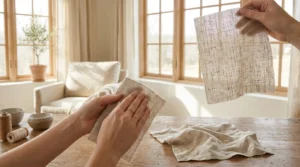
Three quick touches show a fiber’s quality in a shop. First, rub it between two fingers. Linen should feel dry and slightly crisp. Second, crumple a corner for five seconds. Release it and watch the crease (our reading). A cloth that stays flat after crumpling probably holds a synthetic blend.
Third, hold the cloth to the light. A dense weave blocks most of the light. A loose weave shows pinpoints. Choose density by use. A cushion cover needs a dense weave and a curtain needs a loose one. Read the fiber tag after the touch test and not before it.
Texture Budget: $105 Across Four Layers
The four starter layers total $105 by our estimate. Buy the jute rug first because it sets the floor. Add the wool mat second and the linen cover third. The hard bowl comes last. Each purchase can wait a week while the room settles. Prices vary by region and season (our estimate).
A $60 version keeps two layers. It uses the jute rug and the linen cover. This version suits a rental with a bare floor and a plain sofa. Skip the bowl and the mat until the first two feel right. Each skipped item saves its own cost. Add the mat later from a resale shop for less (our reading).
Build Up From the Floor and Stop at Four
To layer organic room textures well, give each one a job. The rug anchors. The curtain lifts. The linen relaxes. The hard surface rests the eye and the repeat ties the layers together. A fifth layer needs a reason before it earns a place. Five textures in a small room usually fight for attention (our reading). Photograph the finished room in daylight to keep a record.
Texture is the cheapest way to add depth to a room. Paint and furniture cost far more. Layers also hide visible wear (our reading). A room built in layers grows slowly and each piece earns its spot before the next one arrives. If this plan helped, share it with a friend who owns a bare room. Tell us in a comment which layer went down first.
Frequently Asked Questions (FAQs)
How do you layer organic room textures?
You layer organic room textures by starting with a coarse floor piece and adding softer pieces as you move upward. Keep each layer one step softer than the one below it. Photograph the room after every addition. A phone photo shows balance faster than the eye does.
Can you mix too many textures in one room?
You can mix too many textures. Squint at the room until the details blur. One object that still pops out is too loud. Remove it first. Return it later if the room feels too quiet.
What textures go with a wood floor?
Jute, wool and linen all go with a wood floor. Pick a rug one shade lighter or darker than the boards. A rug that matches the floor exactly can vanish. A rug that clashes can fight the grain.
Do layered textures work with a leather sofa?
Layered textures work well with a leather sofa. Leather is smooth and slightly cool. Add a wool throw and a linen cushion for contrast. Skip a second leather piece nearby. Two smooth surfaces flatten the layers.
How often should you swap textures by season?
Swap textures twice a year if you want a seasonal feel. Move heavy wool forward in the cooler months. Move linen forward in the warm months. Store the unused set in a breathable cotton bag. Plastic can trap moisture.