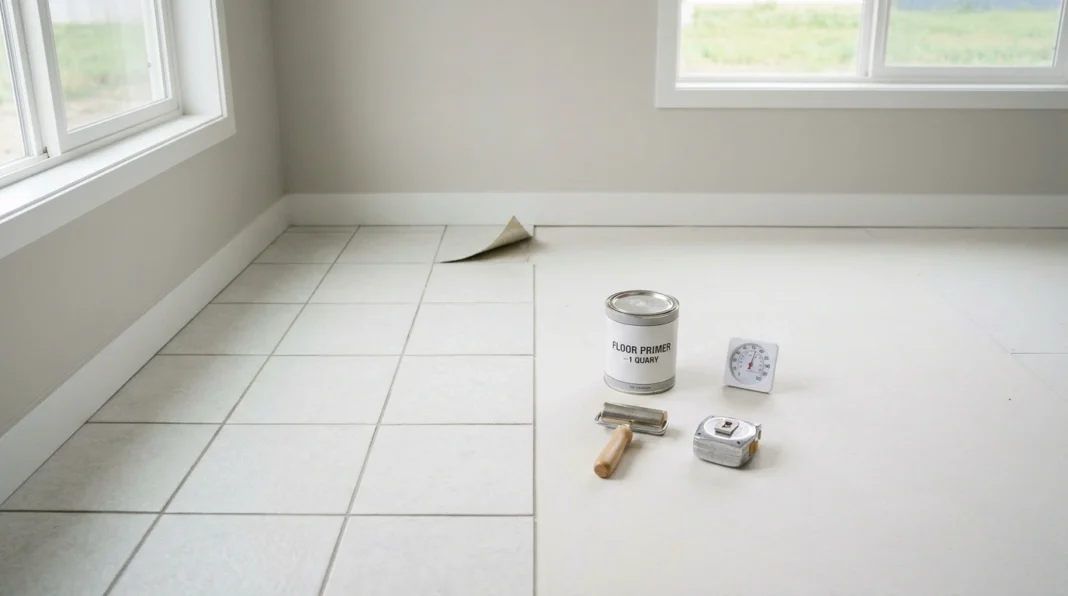
What Makes Cheap Peel Stick Tiles Lift From The Floor
Cheap peel stick tiles peel when pressure, surface or temperature weakens the adhesive bond. Wikipedia says all three change how a pressure-sensitive adhesive grips. Three Home Depot tile cases listed from $20.17 to $32.96 on November 10, 2026. None of the pages show a test result. A FloorPops primer page lists $15.28. A Roberts seam roller page lists $22.77. Prices come from product pages. They can change. I ran no tests. These are listed facts.
Key Takeaways:
- Pressure, surface and temperature all change how an adhesive bond forms, per Wikipedia.
- Three tile cases listed from $20.17 to $32.96 on November 10, 2026.
- The $15.28 primer page says surfaces must be sound, dry and clean.
- A primer and a roller cost $38.05 together.
- None of the checked pages show a test result.
A lifting tile means the bond has failed. Start with the floor. Read what each page says about the surface. The ACHIM Nexus page asks for a flat and dry surface. The primer page asks for a clean surface. Both pages list a 90-day return. Photograph any lifting corner before you act. Mark the return date on your calendar. Compare the three cases below. Decide on the prep before you buy.
Three Checks That Decide If A Tile Stays Down
Three steps help cheap peel stick tiles stay down. First, compare what three tile cases say. Next, learn how an adhesive bond forms and fails. Last, price a primer and a roller. Each step lists sourced facts. Each one also names what the page does not say. Read the limits before you buy.
Three Tile Cases List From $20.17 To $32.96
The ACHIM Nexus White case lists at $20.17 for 20 tiles (verified November 2026). That is $1.01 per square foot. The page names it solid vinyl. It asks for a flat and dry surface. It says the tiles suit concrete and wooden floors. It shows 327 reviews with no star rating. It lists a Prop 65 warning. It makes no removable or permanent claim. Read the page before you order.
The FloorPops Morris Grey case lists at $32.96 for 20 pieces. That is $1.65 per square foot. The ACHIM Retro Stone Herringbone case lists at $32.22. That is $1.61 per square foot. The Retro page shows 475 reviews with no star rating. It says the vinyl resists scratches. Neither page names a subfloor. Neither page makes a removable or permanent claim. Ask the seller before you buy. Save the reply.
How A Peel Stick Adhesive Bond Forms And Fails
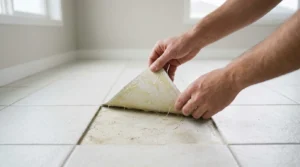
The Wikipedia article on pressure-sensitive adhesive says the adhesive must be soft enough to wet the surface. It must also be hard enough to resist flow under stress (verified November 2026). Those two needs pull against each other. Wikipedia calls these viscoelastic properties. Cool temperatures can make the adhesive too firm. A firm adhesive loses tack. Heat lowers shear holding. A tile floor asks the adhesive to meet both needs for years.
Wikipedia says smoothness, surface energy and cleanliness also affect the bond. It says tapes with pointed corners start to detach at those corners. Rounded corners improve adhesion. Tiles have pointed corners too. That is my reading and not a Wikipedia claim. Wikipedia lists shear and peel resistance as key measures. Initial tack matters too. These depend on the formulation and the coating thickness. The table below details adhesive bond and peel guidelines established by adhesive industry specialists.
| Number & Insight | Source | Expert/Team |
|---|---|---|
| The adhesive must be soft enough to flow and wet the surface. It must be hard enough to resist flow under stress (verified November 2026) | Wikipedia, Pressure-sensitive adhesive | Adhesive industry practice as summarized by Wikipedia |
| Shear resistance, peel resistance and initial tack are the key measures. Standard tests run at 23 °C with 50% relative humidity | Wikipedia, Pressure-sensitive adhesive | Adhesive industry practice as summarized by Wikipedia |
| Tapes with pointed corners start to detach at the corners. Rounding the corners improves adhesion | Wikipedia, Pressure-sensitive adhesive | Adhesive industry practice as summarized by Wikipedia |
| Cool temperatures can make the adhesive too firm. It then loses tack. Heat lowers shear holding | Wikipedia, Pressure-sensitive adhesive | Adhesive industry practice as summarized by Wikipedia |
| The FloorPops primer lists $15.28 for 1 quart. Its page says it covers 87.5 to 100 square feet | Home Depot product page | Seller listing, not independent testing |
A $15.28 Primer And A $22.77 Roller Total $38.05
The FloorPops primer lists $15.28 for 1 quart (verified November 2026). The page says it enhances the bond of the self-stick tile to the subfloor. It covers 87.5 to 100 square feet per quart. That is about four to five cases of tiles. Apply it with a short-nap paint roller or a coarse fiber brush. Do not leave excess primer. It dries in 30 to 90 minutes. Wait until it dries before you lay tiles.
These tips are mine. They do not come from the listings or Wikipedia. They help cheap peel stick tiles grip. Sweep and wipe the floor first. Let it dry fully. Press each tile from the center outward. Press every corner twice. The Roberts 4-inch seam roller lists $22.77. Its page names vinyl seams. It shows 112 reviews with no star value. Use it if your palm tires. Photograph the floor before you start.
How A Cold Room Weakens A $20.17 Tile Case
Wikipedia says a pressure-sensitive adhesive is designed for room temperature. It says the adhesive typically loses tack at low temperatures. Cool temperatures can make it too firm. The ACHIM Nexus page asks for a flat and dry surface. I saw no temperature range in the text I read. The Morris and Retro pages showed none either. Ask each seller for a safe installation temperature. Save the reply with your order receipt.
These tips are mine. They help cheap peel stick tiles bond in a mild room. Warm the room before you start. Keep it mild while you lay tiles. Keep it mild for a day after. Store the unopened case indoors first. Do not rush a cold floor. Check the floor with your hand. Look for damp spots too. Wait for a dry day. Photograph the room on install day. Note the date and the room temperature.
Why A $15.28 Primer Shows 2.9 Out Of 5 Stars
The FloorPops primer page shows 17 reviews at 2.9 out of 5 stars. It also says 100% recommend this product. The page shows both numbers. I cannot explain the gap. Reviews are not tests. Read the lowest ratings first. Look for posts about peeling or a sticky film. Look for posts that name your subfloor. Compare them with the page directions. Skip posts with no details. Note the date of each post.
The page suits concrete or plywood subfloors. It says it does not recommend installing over linoleum or laminate floors. It says to use indoors only. It says surfaces must be sound, dry and clean. The page lists no warranty. It lists a 90-day return. Save your receipt. Mark the last return day on your calendar. Test a small patch before you prime a whole room. That tip is mine. Photograph the label too.
A $38.05 Prep Kit Costs More Than A $32.96 Case.
A $15.28 primer and a $22.77 roller total $38.05. That is $5.09 more than the $32.96 Morris case. The $20.17 Nexus case plus both costs $58.22. That is $1.22 over $57. The Roberts 100-pound floor roller lists $429.99. That is far over budget. Count the full cost before you start. Prep adds up fast. Write down each total. Prep can cost more than tile. Compare the totals on the day you buy.
Renters need a landlord’s written approval before a primer touches the floor. Read renter friendly floor and window fixes under $57 before you decide. A primer is not easy to undo. Check each return window. Every page listed a 90-day return. Keep the cartons until you are sure. Keep every order email in one folder. Check each price on the product page. Photograph the floor before and after. Save the photos.
Conclusion
To keep cheap peel stick tiles down, fix the bond first. Three tile cases checked on November 10, 2026, were listed from $20.17 to $32.96. A primer was listed at $15.28 and a roller at $22.77. Wikipedia says pressure, surface and temperature shape the bond. Clean the floor. Keep the room mild. Press every corner. I ran no tests. These are listed prices that can change. Check each page on the day you buy.
Use the 90-day return window as your safety net. Save each product page and your receipt. Photograph the floor before and after. Ask each seller about the surface and the installation temperature. Save every reply. Test a small patch first. Renters should ask the landlord before any primer goes down. Prep can cost more than tile. Count it early. Keep every order email in one folder. Share your best peel stick tile tip with us.
Frequently Asked Questions (FAQs)
Why do cheap peel stick tiles peel?
Cheap peel stick tiles peel when pressure, surface or temperature weakens the adhesive bond. Wikipedia says all three change how the adhesive grips. Check the surface first. Press every corner. Keep the room mild on install day.
Do you need primer for peel stick tiles?
The FloorPops primer page says it enhances the bond of self-stick tile to the subfloor. It suits concrete or plywood subfloors. The ACHIM Nexus page asks for a flat and dry surface. It names no primer. The primer lists $15.28.
Does cold weather make peel stick tiles lift?
Wikipedia says cool temperatures can make a pressure-sensitive adhesive too firm. A firm adhesive loses tack. The page does not name floor tiles. No tile page I read gave a safe installation temperature. Ask the seller.
Can you lay peel stick tiles over linoleum?
The FloorPops primer page says it does not recommend installing over linoleum or laminate floors. Its Q&A says to remove existing vinyl or prime it first. Ask the tile seller before you start.
How much do cheap peel stick tiles cost?
Three Home Depot cases listed from $20.17 to $32.96 on November 10, 2026. Each case covers 20 square feet. That is $1.01 to $1.65 per square foot. Prices can change. Check the product page on the day you buy.