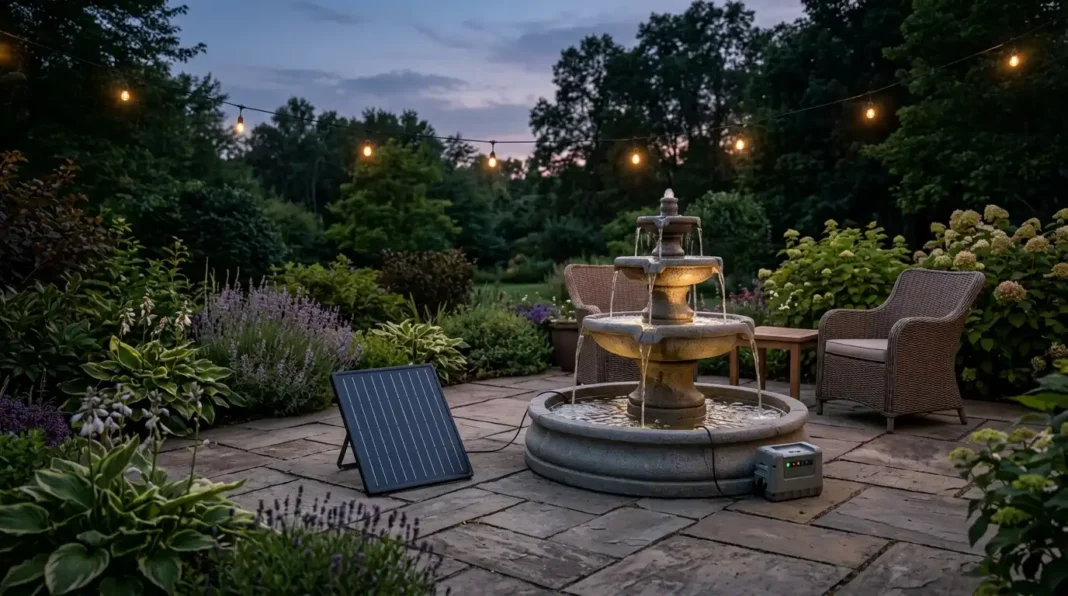
Solar Water Fountains With Battery Explained
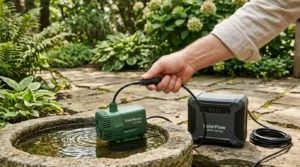
Installing water fountains with battery backup comes down to three moves. Put the panel in full sun. Match its wattage to the pump. Let the battery charge before you count on it after dark. That battery keeps the pump running when the sun drops or clouds roll in. Without it, a solar fountain only works in direct light, and the water stops the second a cloud passes overhead.
Key Takeaways
- Panel in full sun, with its wattage matched to the pump.
- Plan on 2 to 4 hours of battery runtime after sunset, though listings claim about 1 to 6.
- Small kit panels commonly run 1.5 to 3.5 watts.
- A small pump kit with a built-in battery often costs under $40.
- A clogged pump or dirty panel stops many solar fountains before the battery does.
This guide covers panel sizing and four related water and shade builds worth comparing before you buy.
Five Solar Fountain and Shade Guides to Install
Not every set of water fountains with battery backup works the same way. Panel size, battery capacity and pump choice all change how long it actually runs after dark.
The five guides below walk through the decisions in the order they come up, starting with the smallest setup and ending with the shade that goes next to it.
Solar Bird Bath Pumps: What Size Actually Works
Bird bath pumps run small, often only 1 to 3 watts. A 1-watt pump suits a shallow bowl with a gentle bubble. Bigger pumps throw a taller spray, but they drain a small battery faster. Depth matters just as much as watts, though. The Cornell Lab of Ornithology says birdbath water should stay no deeper than 1 inch at the edges and 2 inches in the middle. The table below shows the depth numbers from the Cornell Lab of Ornithology.
| Number & Insight | Source (Institute) | Expert / Team |
|---|---|---|
| Birdbath water should be no deeper than 1 inch at the edges, sloping to a maximum of 2 inches in the middle, and many birds find moving water irresistible. | Cornell Lab of Ornithology | All About Birds |
Match the pump to the bath, not the other way around. A pump too strong for a shallow bird bath splashes water out faster than birds can use it, and that means more refilling for you. Our full guide on best solar powered bird bath fountain pump breaks down wattage by bath size.
Plug-and-Play LED Fountains: What’s in the Box
These kits ship with the panel, pump and LED light ring already wired together, so setup is closer to unboxing than building. The panel connects to the pump by a cable, and that cable’s length limits how far apart you can place them. Check the listed length before you buy. The light ring itself is a small draw. The U.S. Department of Energy says residential LEDs use at least 75% less energy than incandescent lighting. The table below shows the LED efficiency numbers from the U.S. Department of Energy.
| Number & Insight | Source (Institute) | Expert / Team |
|---|---|---|
| Residential LEDs, especially ENERGY STAR-rated products, use at least 75% less energy and last up to 25 times longer than incandescent lighting. | U.S. Department of Energy | DOE Energy Saver |
A small draw isn’t a free draw, though. The LED ring still pulls from the same battery as the pump, so runtime dips a little when both run at once. Our full guide on best plug and play outdoor water fountain with lights covers battery trade-offs between light and flow.
Sizing a Solar Panel for Your Pump
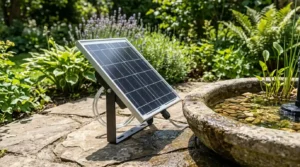
Panel sizing isn’t guesswork. The U.S. Department of Energy’s own methodology for small renewable systems calculates it directly: multiply the pump’s wattage by its daily runtime hours to get watt-hours needed, divide by your site’s sun hours, then add a buffer for system losses. The table below shows the sizing methodology from the U.S. Department of Energy.
| Number & Insight | Source (Institute) | Expert / Team |
|---|---|---|
| Daily energy need is calculated as appliance wattage times hours used, converted to watt-hours; the resulting panel size is then multiplied by roughly 1.2 to buffer against system losses and cloudy days. | U.S. Department of Energy | Sandia National Laboratories |
For a 3-watt pump running 8 hours a day, that’s 24 watt-hours needed. Divide by 5 average sun hours, and you land near 5 watts, times the 1.2 buffer, for a panel closer to 6 watts. Sizing a panel this way is the step that makes water fountains with battery backup actually last through the evening. Read more from the DOE’s small-scale renewable energy sizing guide before buying a panel that undersizes your setup.
Retractable Awnings: When Wind Becomes a Problem
Retractable awnings are often rated for winds somewhere around 20 to 25 mph, so check the rating on your model. That sits close to Beaufort Force 5, which the National Weather Service calls a fresh breeze, a point where small trees in leaf begin to sway. The table below shows the wind numbers from the National Weather Service Beaufort scale.
| Number & Insight | Source (Institute) | Expert / Team |
|---|---|---|
| Beaufort Force 5, a fresh breeze, covers winds of 19 to 24 mph, where small trees in leaf begin to sway. | National Weather Service | NWS Beaufort Wind Scale |
A wind sensor that auto-retracts the awning removes the guesswork entirely. Our full guide on best heavy duty retractable awning for deck covers wind ratings by awning size and frame material.
Shade Sails: What UV Protection Actually Means
A shade sail’s UV rating tells you how much ultraviolet light gets through, not how much heat it removes. The Skin Cancer Foundation explains the UPF scale for fabrics this way: UPF 50 blocks 98 percent of UV rays and lets 2 percent through. UV blocking and heat blocking aren’t the same measurement, so even a high rating still lets real warmth through. The table below shows the UPF numbers from the Skin Cancer Foundation.
| Number & Insight | Source (Institute) | Expert / Team |
|---|---|---|
| A fabric rated UPF 50 blocks 98 percent of UV rays and lets 2 percent through; a UPF of 30 to 49 offers very good protection, and UPF 50+ rates as excellent. | The Skin Cancer Foundation | Skin Cancer Foundation Experts |
Fabric color and weave density affect the quality of shade more than the rating alone. Tension matters as much as fabric choice. A loosely hung sail flaps in wind and sags with rain, which shortens its lifespan regardless of how good the fabric itself is. Our full guide on best waterproof shade sail for small backyard covers tension hardware and anchor point spacing.
The Proven 2-to-4-Hour Runtime Reality Check
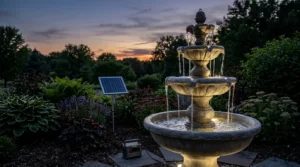
Marketing copy sometimes implies water fountains with battery run all night, every night. Listings for small battery-backup fountains mostly claim 1 to 6 hours, and a few claim 10 or more. Plan on 2 to 4 hours past sunset, and treat the longer claims as best-case numbers under ideal summer sun, not a guarantee for a cloudy week in November.
If overnight operation matters to you, size the battery for your worst month, not your best one. A setup that comfortably runs 4 hours in July might barely manage 90 minutes once winter sun hours shrink.
1 Proven Fix for an Annoying Dim Panel and Green Basin
A solar panel covered in dust, pollen or water spots loses output without any obvious sign something’s wrong. Wipe it with a damp cloth every few weeks, especially after pollen season or a dry spell. Then check the angle. A panel flat on the ground catches far less sun than one tilted toward the sun’s path, and a simple prop or bracket fixes that for free.
The basin needs the same attention. Full sun helps the panel, but it also speeds up algae growth in the water. Scrub the basin weekly with a soft brush and plain water. If you ever use soap, rinse thoroughly before you refill.
Best Budget Solar Fountain Under $40: 2026 Pick
Small floating pump kits with a built-in battery are the usual way to land water fountains with battery backup under $40. Expect a single pump with a few spray nozzle options, not a plug-and-play kit with LED lights at that price.
Battery-free direct-sun kits cost even less, but they stop the instant a cloud blocks the panel. For most patios, the small battery upgrade is worth the extra money.
Solar Water Fountains With Battery Buying Takeaways
Water fountains with battery backup earn their keep the moment a cloud rolls in and the water keeps flowing anyway. Panel sizing matters most. The DOE’s own sizing math works for a small fountain too. Expect 2 to 4 hours of runtime after dark, not the all-night operation some listings imply. Keep the panel clean and tilted toward the sun, and scrub the basin weekly. Small habits like these keep a fountain running from season to season, no matter what the weather brings your way.
If you’re also weighing a raised bed option for your yard, our guide on what are elevated raised garden beds covers those builds in more depth. If this guide helped you plan your setup, let us know in the comments below and share it with friends or family who are shopping for their own solar water feature this season.
Frequently Asked Questions (FAQs)
What is the best outdoor solar water fountain with battery backup?
The best outdoor solar water fountain with battery backup pairs a panel sized at roughly 1.2 times the pump’s power draw with a battery built for 2 to 4 hours of after-dark runtime. That combination keeps the fountain running through cloudy stretches without needing direct sun constantly.
How long does the battery last on a solar fountain?
Plan on 2 to 4 hours past sunset or during a cloudy stretch. Product listings range from about 1 to 6 hours, and exact runtime depends on battery capacity, pump wattage, and how much sun charged the battery that day.
What size solar panel do I need for a fountain pump?
Multiply the pump’s wattage by its daily runtime hours, divide by your site’s sun hours, then add about 20% as a buffer. A 3-watt pump running 8 hours typically needs a panel close to 6 watts.
Why did my solar fountain stop working?
A clogged pump is a common cause, often from algae or debris in the basin. A dirty or shaded panel is another, since less sunlight means less charging. Check both before you blame the battery.
Is a solar fountain with battery backup worth the extra cost?
For most patios, yes. A battery-free direct-sun kit costs less upfront but stops the moment a cloud blocks the panel, while a battery backup keeps water moving through short cloudy spells and into the evening.